

MARKET REVIEW FOREX FED
Hot US CPI Lifts Hike Bets, But Dollar Rally Fades
September inflation ran hotter than forecast and briefly pushed the dollar to an 18-month high. Then bond buyers stepped in, Fed officials played down an October move, and Australia’s jobs data knocked the Aussie lower.
Followme News Desk | October 15, 2026
Executive Summary
US consumer prices rose 0.6% in September, lifting annual inflation to 3.7% from 3.4%, above the 3.6% forecast. Core CPI climbed 0.3% for the month and 2.6% for the year, both a tenth above consensus. The gains were spread widely across shelter, core goods and services, so this was not just an energy story.
The first market reaction was what you would expect. The odds of a Fed hike at the October 27–28 meeting jumped as high as 60%, and the dollar index came close to 103. Neither move held. Treasury futures reversed sharply, the dollar gave back most of its gains by the close, and by Thursday’s Asian session markets were again pricing roughly a 75% chance the Fed holds this month. San Francisco Fed President Mary Daly said more hikes are likely but that there is no urgency to act in October. A December hike remains fully priced.
In Australia, employment fell by 39,300 in September against expectations of a 20,000 gain, and unemployment edged up to 4.7%. AUD/USD dropped to a one-week low below 0.6950.
Next up are US PPI and retail sales today, followed by Fed Chair Kevin Warsh’s speech on Friday.
Market Review
On paper, September’s CPI report gave dollar bulls everything they wanted. Headline prices rose 0.6% on the month, up from 0.4% in August, and the annual rate rose to 3.7%. Core inflation rose 0.3% against a 0.2% forecast. The unrounded figure was 0.335%, close to rounding up to 0.4%. Shelter rose 0.4%, core services 0.4%, and supercore inflation 0.3%. A broader diffusion index showed price increases spreading across more categories. Energy, rents, recreation, education and used vehicles all contributed.
The report also undercut New York Fed President John Williams, who had pencilled in just one more hike this year and none in 2027. Chicago Fed President Austan Goolsbee called the data discouraging and said inflation at this level was unacceptable. Richmond Fed President Thomas Barkin said CPI ran too hot and that he is open-minded about October. The Fed’s Beige Book, also released Wednesday, reported price pressures intensifying in parts of the country, increasingly driven by diesel costs.
The market reaction was less convincing. October hike odds jumped from 22% to 60% immediately after the release, then settled near 42% by the close. Treasury futures came close to their September lows before reversing hard on heavy volume. Two-year futures printed something close to a dragonfly doji, and 10-year futures formed a hammer. Pricing for tightening was pulled forward to earlier meetings, but the total expected by end-2027 slightly declined. In other words, the market accepted that hikes may come sooner but refused to price a higher peak rate.
Daly reinforced that later on Wednesday. In a Reuters interview, she said further increases are more likely than not, but that she feels no need to decide in October. She attributed headline inflation mainly to gasoline and described core inflation as sticky, as she had expected. She also said a stable labour market lets the Fed focus on price stability.
The US Dollar Index (USDX) hit its highest level since April 2025, just shy of 103, then fell back toward the close. On Thursday it extended its retreat as US yields dropped further. That move pushed USD/JPY back below 158. It also helped gold recover toward $4,150 after briefly testing $4,100.
Australia added its own pressure in the Asian session. The Australian Bureau of Statistics reported a 39,300 drop in employment. The decline came entirely from part-time jobs, since full-time employment actually rose 34,400. Unemployment rose to 4.7% and participation slipped to 66.8%. The data cooled expectations of another RBA hike and sent AUD/USD to a one-week low, extending Wednesday’s rejection above 0.7000.
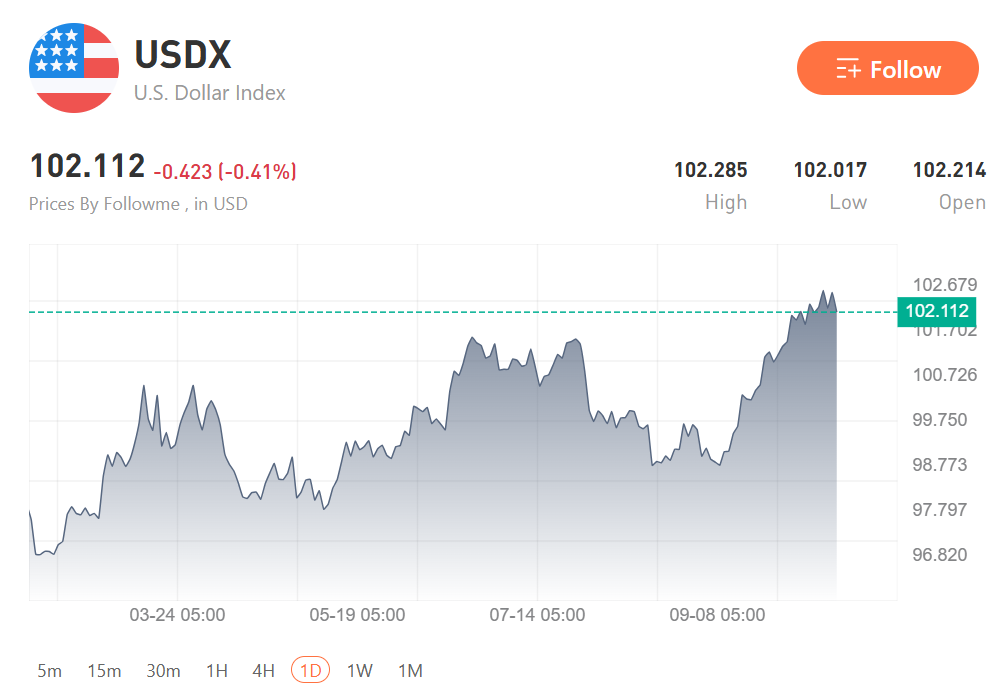
USDX price as of 13 October 2026 - View Live Chart →
The Facts
- US CPI (September): +0.6% m/m (prior 0.4%), 3.7% y/y (forecast 3.6%, prior 3.4%). Core CPI +0.3% m/m (forecast 0.2%), 2.6% y/y (prior 2.4%).
- Inflation breadth: Shelter +0.4%, core goods +0.3%, core services +0.4%, supercore +0.3%. The diffusion index rose, pointing to wider price pressure rather than a pure energy spike.
- Fed pricing: October tightening prices rose from 6.1bp to 9.1bp after CPI. Around 30bp of hikes are priced by December. Expectations for end-2027 slightly declined.
- Fed policy stance: The target range is 3.75%–4.00% after September’s quarter-point hike. Most officials point to December, not October, for the next move.
- Fed speakers: Daly expects more hikes but sees no urgency for October. Goolsbee called the data discouraging. Barkin opens in October. Williams’ earlier call for just one more hike this year now looks under pressure.
- Beige Book: Price pressures intensified in parts of the US, with diesel costs a growing driver.
- USDX: Hit its highest level since April 2025, near 103, then reversed. Momentum indicators are showing bearish divergence.
- Australia jobs (September): Employment -39.3K (forecast +20K, prior +39.5K). Unemployment rate 4.7%, participation rate 66.8%, underemployment 6.3%, youth unemployment 11.1%.
- AUD/USD: Closed Wednesday at 0.6971 after failing above 0.7000. It fell to a one-week low below 0.6950 on Thursday.
What It Means
The key takeaway is not the CPI number itself. It is the market’s refusal to extend the move. A report this strong would normally have pushed yields and the dollar decisively higher. Instead, both reversed within the same session. That suggests positioning was already heavily skewed toward a hawkish Fed, and buyers saw better value in bonds than in chasing the dollar higher.
For dollar traders, this matters because the USDX has tracked two-year Treasury yields closely for much of the year. If Treasury futures are forming a bottom, which the reversal candles suggest, one of the dollar’s main supports starts to weaken. That correlation already loosened around the quarter turn. Without a fresh rise in yields, the dollar has less room to run.
The Fed’s message is consistent on direction but not on timing. Daly’s comments were the clearest pushback yet against an October move. Goolsbee and Barkin sounded more uneasy. For now, December is the anchor. Oil is the variable that could change that. Daly tied headline inflation directly to gasoline prices, and continued Houthi attacks on Saudi oil infrastructure keep crude supply risk high. A further spike in energy prices would test her view that the Fed can wait.
For the Aussie, the jobs report needs some context. The weakness came from part-time roles, full-time employment rose, and hours worked edged higher. The ABS also adjusted weights for one Victorian survey group and advised caution on month-to-month changes. Trend unemployment held at 4.6%. Even so, the headline was soft enough to make an RBA hike harder to justify. That leaves AUD/USD dependent on whether the US dollar keeps falling.
There is also a risk-off angle. Tech stocks turned volatile on Wednesday, coinciding with the bond reversal, so some of the buying in Treasuries may have been safe-haven flows. If doubts over AI spending grow, US growth expectations could soften. That would put yen-funded carry trades at risk and add downside pressure on USD/JPY.
What Traders Should Watch
USDX near 103: This is the ceiling . The dollar just failed to break. If it is not clear that level after inflation reports this heat, upside momentum is fading. Watch whether the bearish RSI divergence develops into a MACD sell signal.
US PPI, retail sales and jobless claims (today): Strong producer prices would confirm the CPI signal and could revive October hike bets. A soft print would strengthen the case for waiting until December.
Fed Chair Warsh (Friday): This is likely the last major Fed signal before the pre-meeting blackout. Warsh referenced the diffusion measure at Jackson Hole before signalling a resumption of hikes, and that measure jumped in September.
USD/JPY around 158: The pair is testing the lower edge of a rising wedge. A clean break targets 157, then 156.95 and 156.40, with heavier support at 155.50–155.00. Resistance sits at the 200-day moving average near 158.57, then 159. The threat of Japanese intervention continues to limit upside to near 160.
AUD/USD: Former trendline support near 0.6960 has turned into resistance, followed by 0.6986 and the 0.7015 swing high. Support sits at 0.6946, then 0.6905.
Gold: The recovery toward $4,150 depends on falling yields. Energy-driven inflation risk keeps a Fed hike on the table, which could limit gains.
Oil and Middle East headlines: Further attacks on Gulf energy infrastructure would push crude higher and strengthen the case for an earlier Fed hike.
The Bottom Line The data delivered a clear hawkish surprise, but the market did not follow through. Until the dollar can hold above 103 or Treasury yields resume their climb, the post-CPI reversal is the more important signal. Today’s PPI and Warsh’s speech on Friday will determine whether that reversal holds.
Follow us for daily market insights, analysis, and the tools you need to trade with confidence.
Want to stay ahead of major macro developments that move the market? 👉 Follow Followme and check out the Weekly Economic Calendar
October 15, 2026 | This report is for informational purposes only and does not constitute financial advice. © 2026 Followme News
Download Followme Application


Follow us on:


면책 조항: 본 게시글에 표현된 견해는 전적으로 작성자의 견해이며 Followme의 공식 입장을 대변하지 않습니다. Followme는 제공된 정보의 정확성, 완전성 또는 신뢰성에 대해 책임을 지지 않으며, 서면으로 명시적으로 언급되지 않는 한 해당 내용을 기반으로 취해진 어떠한 조치에 대해서도 책임을 지지 않습니다.