



MARKET REVIEW US ECONOMY Global Markets
Services Hold the Line, But the Fed's Risk Calculus Just Flipped
ISM slows, S&P Global rises, and the Fed's tone just shifted.
Followme News Desk | July 7, 2026, Washington
The US services sector is still growing. That's the headline from Monday's ISM Services PMI, which came in at 54.0 for June, a step down from May, but still comfortably in expansion territory. A few hours later, S&P Global's rival survey told the opposite story on direction: its gauge actually rose to a four-month high. Both surveys agree services are still growing, they just don't agree on which way the needle moved this month, with ISM easing and S&P Global picking up. Governor Christopher Waller was in Rome talking about the risks of overly rigid forward guidance, and separately told reporters the balance of risks has "flipped", inflation picking back up while the labor market looks steadier. That's a real change in tone from where Fed messaging has been.
The Facts
- ISM Services PMI: 54.0 in June, down 0.5 point from May's 54.5. The 24th consecutive month of expansion. Steve Miller, who chairs ISM's Services Business Survey Committee, noted all four subindexes stayed above their 12-month averages.
- Business Activity Index: 55.4, down 2.3 points from May's 57.7.
- New Orders: 55.1, down 2.2 points from May's 57.3.
- Employment Index: 51.2, up 3.3 points and back in expansion after three straight months of contraction. ISM's commentary linked part of the jump to World Cup-related hiring in host cities.
- Prices Index: 67.7, down 3.6 points and the first sub-70 reading since February, though diesel, gasoline and related fuel costs were again the most commonly cited items rising in price, not falling.
- 14 of 18 service industries reported growth in June, down from 17 in May.
- S&P Global's competing survey (roughly 400 firms, different methodology): Services Business Activity Index rose to 51.2 from 50.7, a third straight month of growth and a four-month high. Chief Business Economist Chris Williamson called it the strongest pace since the Middle East conflict began, while noting growth still hasn't caught up to pre-conflict levels.
- S&P Global also found that outside the World Cup hiring boost, firms cut headcount for the third time in four months, a blunter read on jobs than ISM's headline number suggests.
- Fed Governor Waller's Rome speech argued that current conditions, not historical averages, should guide policy, and that rigid forward guidance can backfire when conditions shift fast (his example: the Fed's 2020 guidance).
- Waller was quoted that the Fed's inflation commitment hasn't wavered, and that the risk balance has "flipped", the labor market looking more stable, inflation "taking off" again.
What It Means
BMO's Priscilla Thiagamoorthy summed the ISM report up about right: reassuring on jobs, but with price pressure still elevated enough that this alone won't move the Fed. The two employment readings taken together are the most important number in this whole release, and not for a good reason. A one-month hiring poll explained mostly by World Cup logistics isn't evidence the labor market has turned. If anything, S&P Global's finding that firms are still cutting outside of that effect is the more honest signal.
That's exactly the backdrop Waller's comments landed on. Describing the risk balance as having "flipped", inflation reaccelerating, the labor market looking stable is a different emphasis than the "protect the labor market" framing that's dominated Fed talk for months. His Rome speech reinforced the same instinct: policy should follow current conditions, not a preset path, and being locked into guidance can do real damage when the picture changes fast. Put plainly, Waller sounds like someone building the case for staying nimble rather than committing to more cuts, which matters more for near-term Fed pricing than the PMI print itself.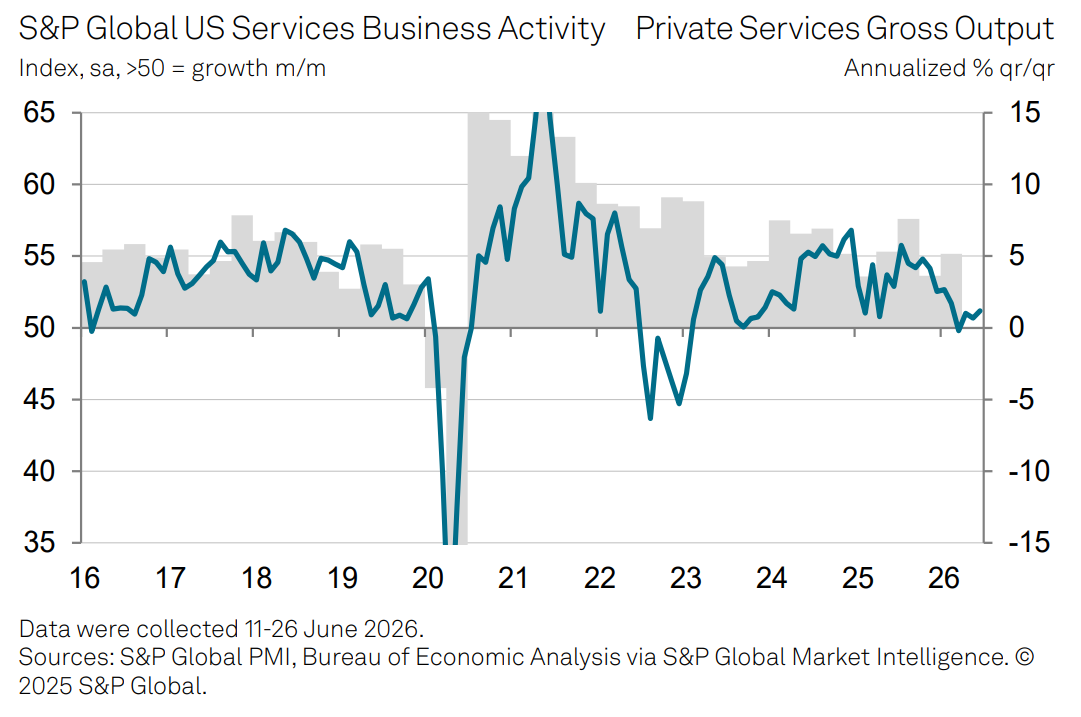
What Traders Should Watch
USDX - Waller's "risks have flipped" language leans hawkish relative to recent Fed messaging; if other officials echo it, front-end yields and the dollar has room to firm.
Rate-cut pricing - a Fed watching inflation "take off" again is less likely to validate aggressive easing bets; watch Fed funds futures for repricing after Waller's comments.
Equities, especially rate-sensitive sectors - steady-but-unspectacular services growth plus sticky prices is the kind of mixed signal markets often struggle to trade; volatility could stay compressed until the next data point forces a re-rate.
Services employment - the June hiring bounce was tied largely to World Cup activity. July's ISM and payroll data (due August 5 for ISM) will show whether that holds or the prior freeze pattern resumes.
The Bottom Line None of this changes the broad picture much on its own. Services are still expanding, prices are still cooling from a high base, and the Fed is still data-dependent. For months, the story was about a Fed protecting a fragile labor market from further damage. Waller's comments suggest at least one voice on the committee is now more worried about inflation reasserting itself than about jobs slipping further. Whether that view spreads before the next meeting and whether June's hiring bounce survives contact with July's data, is what actually moves markets from here, not the headline PMI number itself.
Follow us for daily market insights, analysis, and the tools you need to trade with confidence.
Want to stay ahead of major macro developments that move the market? 👉 Follow Followme and check out the Weekly Economic Calendar
July 7, 2026 | This report is for informational purposes only and does not constitute financial advice. © 2026 Followme News




면책 조항: 본 게시글에 표현된 견해는 전적으로 작성자의 견해이며 Followme의 공식 입장을 대변하지 않습니다. Followme는 제공된 정보의 정확성, 완전성 또는 신뢰성에 대해 책임을 지지 않으며, 서면으로 명시적으로 언급되지 않는 한 해당 내용을 기반으로 취해진 어떠한 조치에 대해서도 책임을 지지 않습니다.

- 끝 -