

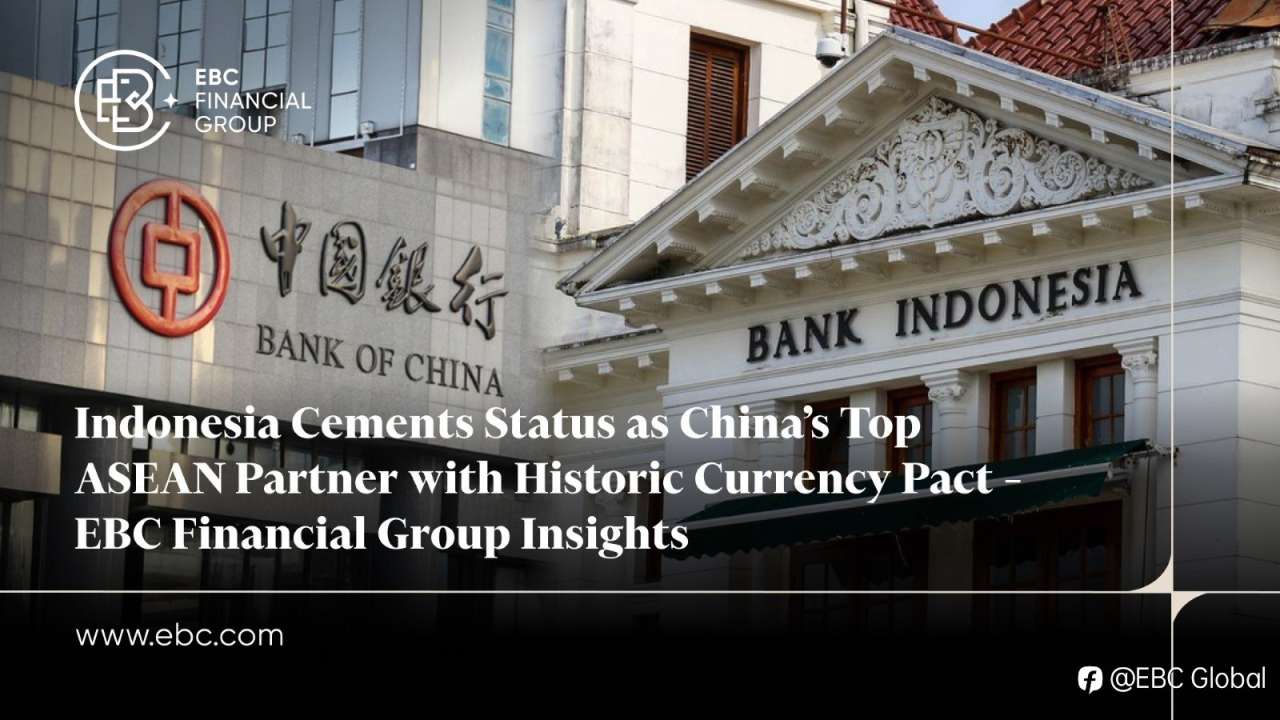
Indonesia’s expanded currency agreement with China, enabling greater use of the Yuan and Rupiah in cross-border transactions, marks a pivotal moment in ASEAN’s financial evolution. EBC Financial Group analyses how this pact, supported by sectoral agreements and the Local Currency Settlement (LCS) framework, is reshaping Indonesia’s economic strategy and influencing regional and global markets.
The Historic Currency Pact: Strengthening Indonesia’s Financial Foundations
EBC highlights that during Chinese Premier Li Qiang’s state visit, Indonesia and China signed four new Memoranda of Understanding, with the upgraded LCS agreement between Bank Indonesia (BI) and the People’s Bank of China (PBOC) at its core. This deal allows for direct Rupiah-Yuan transactions for trade, investment, and even capital account flows, reducing reliance on the US dollar and enhancing Indonesia’s financial resilience.
Sectoral Agreements: Driving Real Economic Impact
According to EBC, the bilateral accords signed on 25 May 2025 lay the groundwork for deeper cooperation across multiple sectors:
- Trade and Tourism: Indonesia is set to welcome nearly 2 million Chinese visitors in 2025, aided by streamlined visa policies and improved payment systems.
- Industrial Development: A USD5 billion commitment to develop twin industrial parks between Fujian and the Batang Special Economic Zone (SEZ) is projected to create over 100,000 jobs.
- Healthcare and Media: Joint tuberculosis vaccine research and expanded media collaboration are expected to strengthen people-to-people ties and soft power.
EBC notes that these sectoral wins are directly linked to the LCS framework, supporting broader economic integration and growth.
The LCS Framework: Enhancing Sovereignty and Policy Options
EBC’s analysis identifies three strategic benefits of the upgraded LCS agreement:
- Trade Shield: Direct Rupiah-Yuan transactions allow Indonesian exporters—especially in commodities like palm oil and nickel—to avoid costly and volatile USD conversions, stabilising trade flows.
- Policy Buffer: With 5.3% of Indonesia’s reserves already held in Yuan, BI gains greater flexibility to adjust monetary policy, such as cutting rates, without destabilising the Rupiah.
- Access to BRICS+ Funding: The pact opens new channels for infrastructure financing through the New Development Bank (NDB), supporting Indonesia’s USD20 billion infrastructure agenda while reducing reliance on dollar-denominated debt.
As David Barrett, CEO of EBC Financial Group (UK) Ltd, explains, “This isn’t just about cutting transaction fees—it’s a recalibration of Indonesia’s financial DNA. By enabling Yuan-backed trade and investment flows, BI is building a hedge against Fed policy shocks.”
Implications for ASEAN and Global Markets
EBC observes that Indonesia’s move is part of a broader ASEAN trend. China-ASEAN trade reached 2.38 trillion Yuan (approx. USD330 billion) in early 2025, up 9.2% year-on-year. The upgraded China-ASEAN Free Trade Area (CAFTA) 3.0 and the recent ASEAN-GCC-China Summit in Kuala Lumpur highlight a regional drive for deeper integration, digital and green economy development, and diversified financial collaboration.
While not an explicit “post-dollar” strategy, EBC believes these developments signal ASEAN’s intent to build more resilient and diversified economic partnerships, reducing overreliance on any single currency and enhancing regional cohesion.
EBC’s Takeaway
Indonesia’s Yuan-Rupiah pact with China is more than a bilateral milestone—it is, in EBC’s view, a template for emerging markets seeking greater financial sovereignty and flexibility. By embracing local currency settlement, fostering sectoral growth, and pursuing diversified partnerships, Indonesia is helping to chart a new course for ASEAN and the global economy.
Disclaimer: This material is for general information purposes only and is not intended as (and should not be considered to be) financial, investment or other advice on which reliance should be placed. No opinion given in the material constitutes a recommendation by EBC or the author that any particular investment, security, transaction or investment strategy is suitable for any specific person.
면책 조항: 본 게시글에 표현된 견해는 전적으로 작성자의 견해이며 Followme의 공식 입장을 대변하지 않습니다. Followme는 제공된 정보의 정확성, 완전성 또는 신뢰성에 대해 책임을 지지 않으며, 서면으로 명시적으로 언급되지 않는 한 해당 내용을 기반으로 취해진 어떠한 조치에 대해서도 책임을 지지 않습니다.

더 오래된 의견은 없습니다. 소파를 가장 먼저 잡으십시오.