


| Scenario | |
|---|---|
| Timeframe | Weekly |
| Recommendation | BUY STOP |
| Entry Point | 1.3920 |
| Take Profit | 1.4038, 1.4160 |
| Stop Loss | 1.3830 |
| Key Levels | 1.3549, 1.3671, 1.3796, 1.3916, 1.4038, 1.4160 |
| Alternative scenario | |
|---|---|
| Recommendation | SELL STOP |
| Entry Point | 1.3795 |
| Take Profit | 1.3671, 1.3549 |
| Stop Loss | 1.3890 |
| Key Levels | 1.3549, 1.3671, 1.3796, 1.3916, 1.4038, 1.4160 |
Current trend
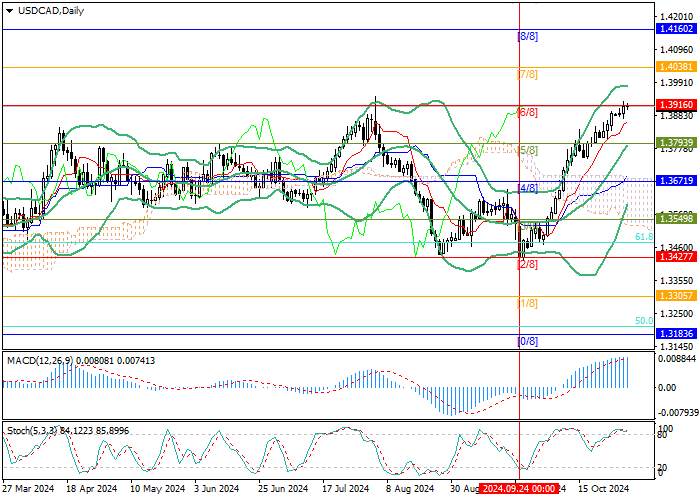
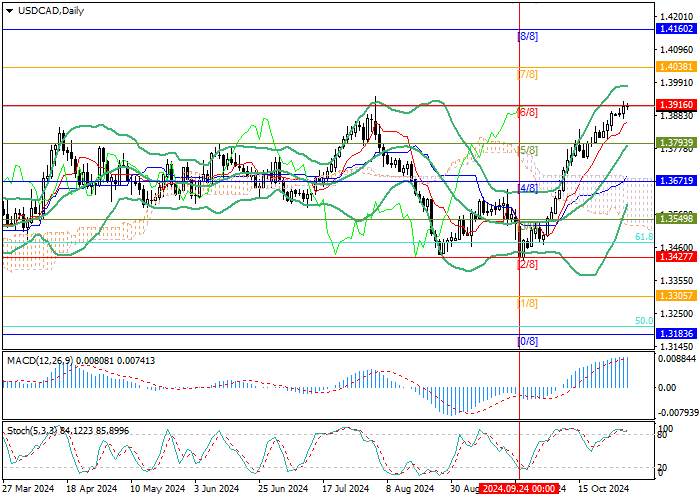
The USD/CAD pair has been rising for the sixth week in a row and is currently testing the 1.3916 (Murrey level [1/8]) mark amid the divergence of monetary rates between the US Federal Reserve and the Bank of Canada, which last week cut its key rate for the fourth time in a row, this time by 50 basis points.
Speaking in parliament, the head of the Canadian regulator Tiff Macklem justified such actions by returning inflation to the target level of 2.0% and noted that to strengthen the Canadian economy in 2025 and 2026, further reduction in borrowing costs is necessary, which will support demand. These statements suggest a continuation of the “dovish” course of monetary policy in the near future.
On the contrary, most experts expect the US Federal Reserve officials to slow the rate of interest rate cuts in November from 50 basis points to 25 basis points amid signs of a strengthening labor market and a weaker-than-expected slowdown in inflation: according to the latest data, employment increased by 254.0 thousand in September, and unemployment fell to 4.1%, while the rate of consumer price growth increased by 2.4% instead of the expected 2.3%. In these conditions, the rhetoric of the regulator's board members has changed to a more cautious one: most officials believe that there is no need to rush to reduce the cost of borrowing. Some market representatives, for example, the CEO of the investment company BlackRock, Larry Fink, even believe that the US Federal Reserve may limit itself to only one interest rate cut by the end of this year instead of the two previously expected. The October consumer confidence statistics published yesterday only reinforce this opinion: the indicator rose from 99.2 points to 108.7 points, demonstrating the economy’s resilience to the current measures of the American regulator.
Thus, the fundamental background favors the continuation of the upward dynamics of the USD/CAD pair in the medium term.
Support and resistance
Technically, the price is testing the 1.3916 mark (Murrey level [6/8]), the breakout of which will ensure the continuation of the growth of quotes to the targets of 1.4038 (Murrey level [7/8]) and 1.4160 (Murrey level [8/8]). If the level of 1.3796 (Murrey level [6/8]), supported by the central line of Bollinger bands, is broken down, the decline may resume to 1.3671 (Murrey level [4/8]) and 1.3549 (Murrey level [5/8]).
Technical indicators confirm the continuation of the uptrend: Bollinger Bands are directed upwards, MACD is increasing in the positive zone, Stochastic may leave the overbought zone, which increases the probability of a corrective decline, but its potential seems limited.
Resistance levels: 1.3916, 1.4038, 1.4160.
Support levels: 1.3796, 1.3671, 1.3549.
Trading tips
Long positions can be opened above 1.3916 with targets at 1.4038, 1.4160 and a stop-loss at 1.3830. Implementation period: 5–7 days.
Short positions should be opened below the 1.3796 mark with targets at 1.3671, 1.3549 and a stop-loss at 1.3890.
면책 조항: 본 게시글에 표현된 견해는 전적으로 작성자의 견해이며 Followme의 공식 입장을 대변하지 않습니다. Followme는 제공된 정보의 정확성, 완전성 또는 신뢰성에 대해 책임을 지지 않으며, 서면으로 명시적으로 언급되지 않는 한 해당 내용을 기반으로 취해진 어떠한 조치에 대해서도 책임을 지지 않습니다.

더 오래된 의견은 없습니다. 소파를 가장 먼저 잡으십시오.