


| Scenario | |
|---|---|
| Timeframe | Intraday |
| Recommendation | SELL STOP |
| Entry Point | 147.00 |
| Take Profit | 146.00 |
| Stop Loss | 147.51 |
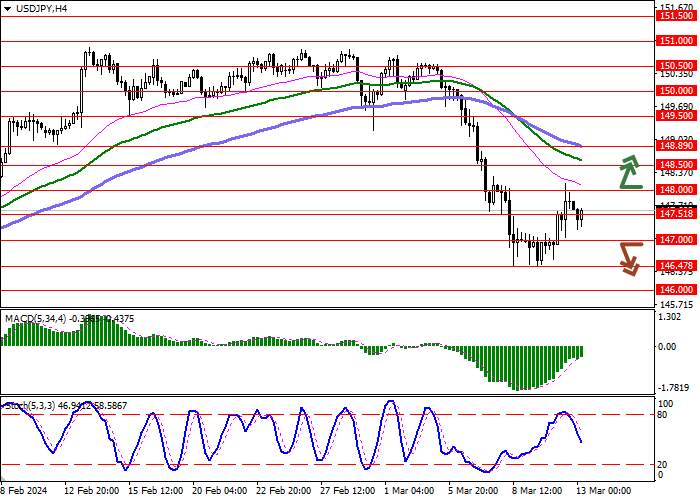
| Key Levels | 146.00, 146.47, 147.00, 147.51, 148.00, 148.50, 148.89, 149.50 |
| Alternative scenario | |
|---|---|
| Recommendation | BUY STOP |
| Entry Point | 148.00 |
| Take Profit | 148.89 |
| Stop Loss | 147.51 |
| Key Levels | 146.00, 146.47, 147.00, 147.51, 148.00, 148.50, 148.89, 149.50 |
Current trend
USD/JPY shows mixed dynamics, consolidating near 147.60. The day before, the instrument showed quite active growth, which was associated with the publication of statistics on consumer inflation in the United States, which turned out to be higher than market expectations.
The Core Consumer Price Index in February added 0.4% in monthly terms and 3.8% in annual terms, which was higher than the forecasts of 0.3% and 3.7%, respectively, and the main indicator accelerated from 3.1% to 3.2%. Analysts took these data as a signal for a possible continuation of the US Federal Reserve's wait-and-see policy regarding a possible reduction in borrowing costs this year. At the same time, as before, investors expect at least three adjustments to the rate by the end of 2024, if the price situation remains within the forecasts.
In turn, the yen is receiving support amid expectations of a possible abandonment of the Bank of Japan's policy of negative interest rates. Some analysts admit that the regulator may resort to such a step as early as April, awaiting additional comments from officials at a meeting next week. At the same time, the Governor of the Bank of Japan, Kazuo Ueda, noted the day before that the Japanese economy is showing signs of recovery, although significant risks are still present. However, household spending is improving moderately on hopes of higher wages in the future, so the regulator is likely to raise interest rates by 20 basis points to 0.10%.
Japan's producer inflation data supported the yen, with the Producer Price Index accelerating 0.2% in February from flat the previous month, while analysts had expected 0.1%, and the PPI rising from 0.2% to 0.6% YoY, also ahead of forecasts of 0.5%.
Support and resistance
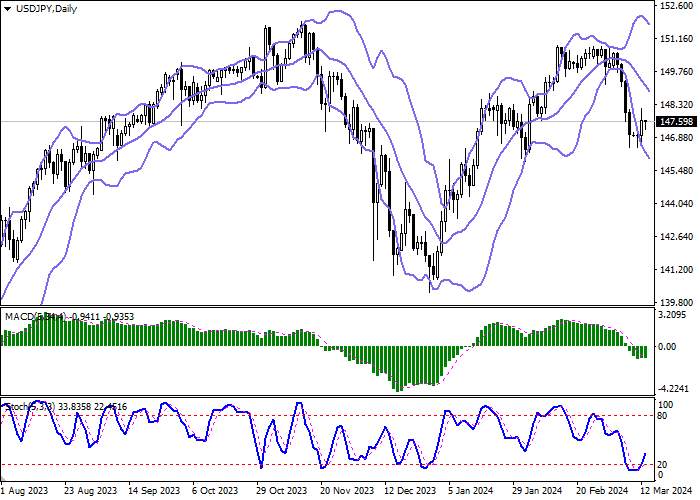
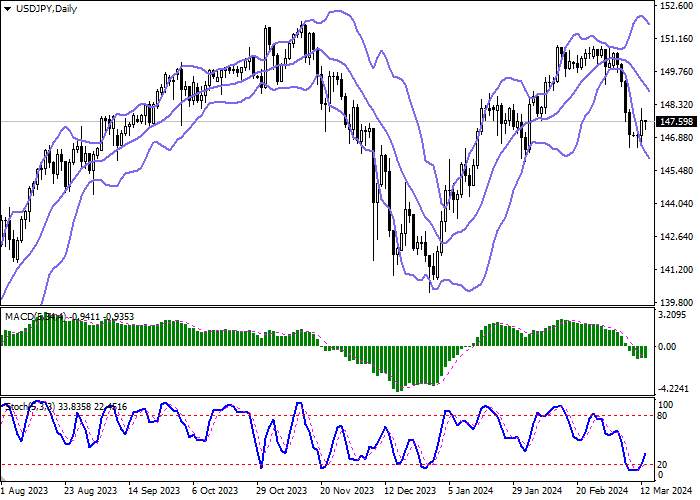
Bollinger Bands on the daily chart show a steady decline. The price range is expanding, being spacious enough for the current activity level in the market. MACD is reversing into an upward plane, forming a new buy signal (the histogram tends to be above the signal line). Stochastic, having rebounded from its lows, maintains active upward dynamics, signaling in favor of the development of a "bullish" trend in the near future.
Resistance levels: 148.00, 148.50, 148.89, 149.50.
Support levels: 147.51, 147.00, 146.47, 146.00.
Trading tips
Short positions may be opened after a breakdown of 147.00 with the target at 146.00. Stop-loss — 147.51. Implementation time: 2-3 days.
The return of the "bullish" trend with the breakout of 148.00 may become a signal for new purchases with the target of 148.89. Stop-loss — 147.51.
면책 조항: 본 게시글에 표현된 견해는 전적으로 작성자의 견해이며 Followme의 공식 입장을 대변하지 않습니다. Followme는 제공된 정보의 정확성, 완전성 또는 신뢰성에 대해 책임을 지지 않으며, 서면으로 명시적으로 언급되지 않는 한 해당 내용을 기반으로 취해진 어떠한 조치에 대해서도 책임을 지지 않습니다.

더 오래된 의견은 없습니다. 소파를 가장 먼저 잡으십시오.