


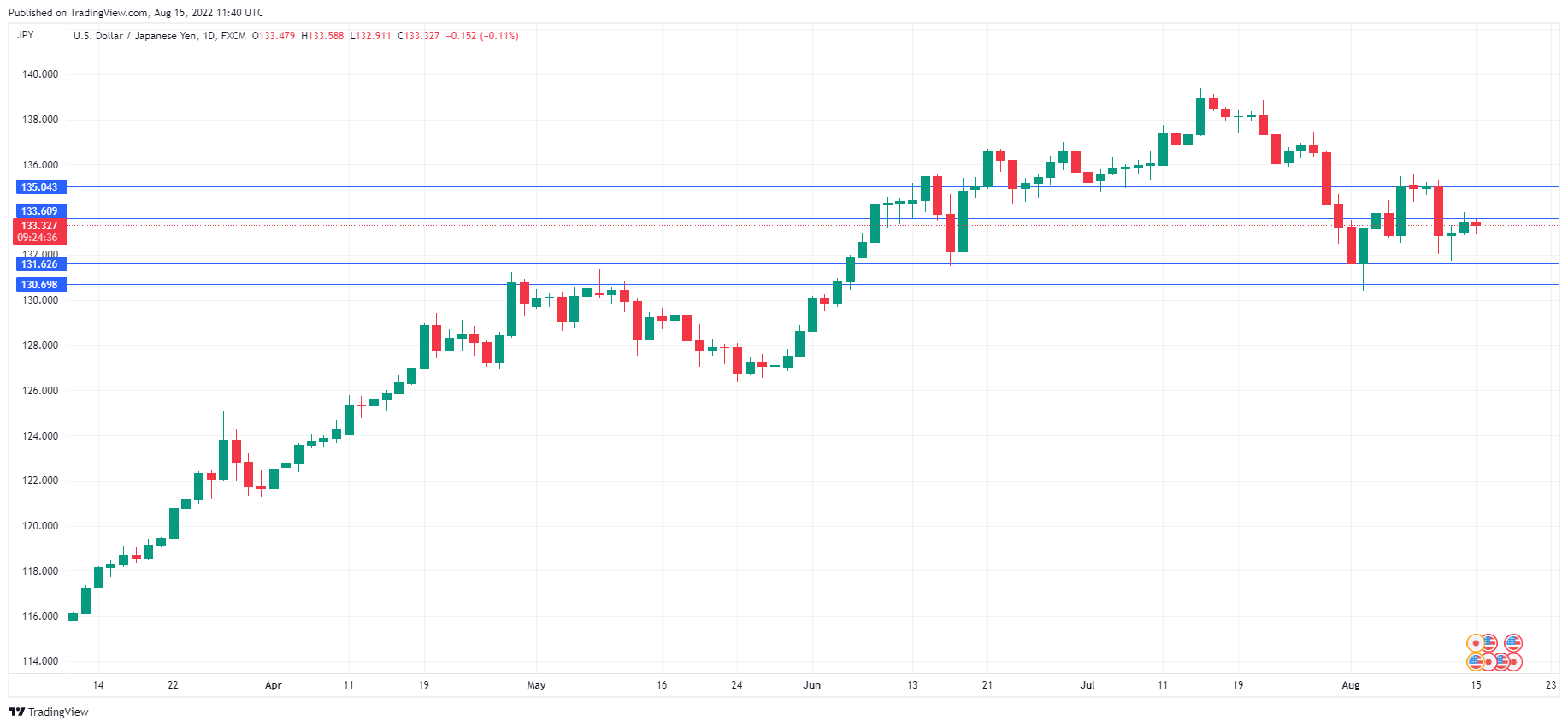
The Japanese yen has started the week quietly. In the European session, USD/JPY is trading at 133.29, down 0.14%. This follows a positive week for the yen, in which USD/JPY declined by 1.15%.
Japan’s economy expands by 0.5%
Japan’s GDP for the second quarter rose 0.5%. The reading was a notch below the forecast of 0.6%, and the yen showed little interest. Domestic consumption, which makes up some 60% of Japan’s GDP, rose by 1.1%, reflective of pent-up demand after Covid restrictions were lifted in March. As well, exports increased by 0.9%, in Q2, certainly good news as the global economic outlook remains gloomy. On an annualized basis, GDP rose 2.2%, shy of the estimate of 2.6%. Still, the reading indicated that Japan’s economy has returned to its pre-Covid size, although the recovery has lagged behind other major industrial countries.
What does the GDP reading mean for the Bank of Japan? In all likelihood, not very much. Inflation has risen slightly above the BoJ’s 2% target, but is low compared to other major economies, which are grappling with red-hot inflation and have embarked on an aggressive rate-tightening cycle. Prices have been rising more quickly than wages, meaning that real wage growth has been on the decline. As well, inflation has largely been driven by high commodity prices, which may not be a long-term trend. Until there are signs that inflationary pressures are broadly based, the BoJ will do little more than tweak its policy. For the BoJ, the primary focus is not inflation, as is the case with the Fed and the BoE, but rather the need to support the economy. This means “business as usual” for the BoJ until it is convinced that inflation is sustainable.
USD/JPY Technical
- 133.60 is a weak resistance line, followed by 1.3504
- There is support at 131.62 and 130.70
면책 조항: 본 게시글에 표현된 견해는 전적으로 작성자의 견해이며 Followme의 공식 입장을 대변하지 않습니다. Followme는 제공된 정보의 정확성, 완전성 또는 신뢰성에 대해 책임을 지지 않으며, 서면으로 명시적으로 언급되지 않는 한 해당 내용을 기반으로 취해진 어떠한 조치에 대해서도 책임을 지지 않습니다.

