


#OPINIONLEADER# #USDollarIndex#
Dollar Index – The Road To 100 Has Started

ByJin Dao Tai
NOV 20, 2021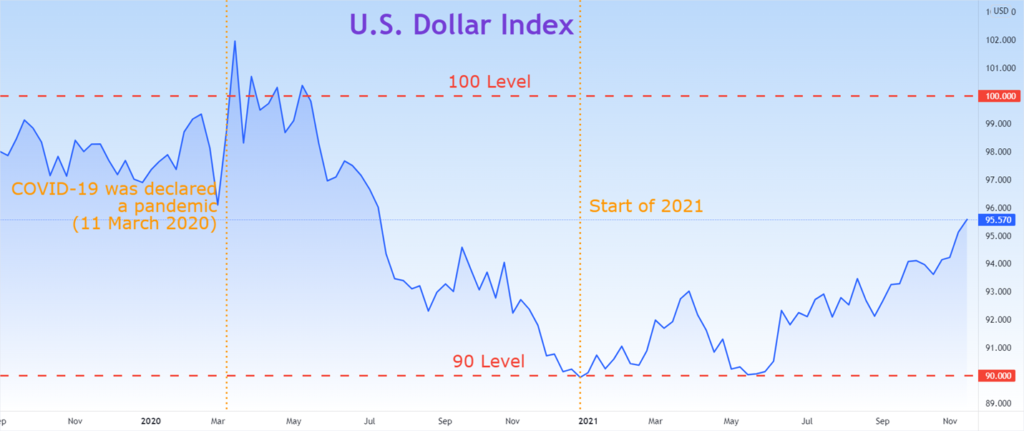
U.S. dollar index: Since the start of the pandemic
When COVID-19 was declared a global pandemic on 11 March 2020, market participants around the world flee from risky financial instruments towards safe haven assets such as the U.S. dollar. This led to the strong demand for the U.S. dollar, causing the U.S. dollar index to spike above the 100 level temporarily. As the chaos started to ease during the second quarter of last year, together with the unprecedented monetary policy decisions carried out by the Federal Reserve, the dollar index started losing ground, plunging to as low as the 90 level by the end of 2020.
2021 kickstarted with a slow but steady recovery of the dollar index. However, with the speedy COVID vaccination programme in the U.S. enforced by the newly sworn-in President Joe Biden, the number of infected cases declined tenfold. And as a result, market sentiment shifted optimistically as justified by the rally of the major U.S. stock indices, causing the demand of U.S. dollar to fall, once again pushing the dollar index down to test the 90 level.
Failing to break below the 90 level, the dollar index has once again started its recovery towards the pre-pandemic level. When Fed Chairman Jerome Powell hinted at a tapering of the central bank’s massive $120 billion per month quantitative easing (QE) programme during the Jackson Hole Symposium in August, it further boosted the dollar index. And as the Fed finally made an official QE tapering announcement during its recent monetary policy meeting, the dollar index is all set to go.
Dual mandate: Price stability, aka inflation
The first of the dual mandates of the Fed is price stability and it relates directly to the level of inflation in the U.S. In order for the Fed to consider a rate hike, inflation will have to exceed the central bank’s 2% target for an extended period time under the Average Inflation Targeting (AIT) policy adopted in 2020. This seems pretty effortless to achieve as upwards pressure on prices has been strong for quite some time already.
Just last Wednesday, the U.S. Bureau of Labor Statistics (BLS) reported annual headline inflation in October to be at a 31-year high level of 6.2% while core inflation was at its 30-year high level of 4.6%. Clearly, such data is very supportive of an interest rate hike. When inflation first exceeded the Fed’s target few months ago, Powell argued that the spike in inflation was partly due to base effect and is expected to be transitory. This happens when the tabulated inflation data includes data from the first few months of recovery which are expected to be strong as the economy is recovering from the initial chaotic situation.
However, as the old data points were being replaced with the new ones, we see that inflation remains strong, even breaking decade-high levels. Formally, the Fed has also revised its recent interest rate statement, softening its tone towards inflation being transitory. With the release of the recent inflation data, the market is now beginning to price in the first interest rate hike to take place during the third quarter of 2022 once tapering ends.
Dual mandate: Maximum employment
The second mandate of the Fed is maximum employment. This is a goal that the central bank has yet achieved but is making substantial progress towards. When the pandemic hits, 22.2 million jobs were lost in the U.S. across two months. Ever since then, it has been a slow and rough journey for the job market to make a comeback. Fortunately, recent jobs report that were initially deemed disappointing were later subjected to upwards revision, thus indicating that more jobs were being added into the economy than initially announced, pushing employment closer towards its pre-pandemic level.
The jobs report for October that was released days after the recent monetary policy meeting stated that 531,000 jobs were created while the jobs figures for September and August were revised upwards by a total of 235,000 jobs. All in all, 766,000 jobs have been added to the record and the job market is now around 4.3 million jobs away from the pre-pandemic level. Performing a quick computation, we see that if the job market continues to create around 540,000 jobs every month for six consecutive months, it will be able to return to its pre-pandemic level by June 2022, which is around the period where QE tapering ends (suppose the tapering rate remains unchanged at $15 billion per month).
The rally has started
At the time of writing, the dollar index is trading at the 95.5 level. With the latest set of inflation and jobs report supporting the Fed’s tapering decision, we may be seeing the strengthening of the dollar index continue for the time being.
Apart from the hawkish move coming from the Fed, bear in mind that the euro, which makes up 57.6% of the dollar index, is facing a renewed tension with the UK over Brexit, specifically on the borders of Northern Ireland. As such, this ongoing tension is having a downward pressure on the euro, thus indirectly aiding the dollar index in its rally. Although the dollar index is still quite a distance away from the 100 level, we can be certain that the engine has started and soon will come close to the pre-pandemic level. And as the U.S. economy recovers with the possibility of a rate hike coming in from the Fed next year, the dollar index may come close to the 100 level by mid-2022.
면책 조항: 본 게시글에 표현된 견해는 전적으로 작성자의 견해이며 Followme의 공식 입장을 대변하지 않습니다. Followme는 제공된 정보의 정확성, 완전성 또는 신뢰성에 대해 책임을 지지 않으며, 서면으로 명시적으로 언급되지 않는 한 해당 내용을 기반으로 취해진 어떠한 조치에 대해서도 책임을 지지 않습니다.

