


As we said earlier, in order for someone to invest in a particular stock market, one would need the local currency in order to purchase stocks.
You can imagine the effect that stock markets like the DAX (that’s the German stock market), have on currencies.
In theory, whenever the DAX rises, we can probably expect the euro to rise as well, as investors need to get a hand on some euros.

While the correlation is imperfect, statistics show that it still holds pretty accurately.
We here did a little research of our own and found out that EUR/JPY seems to be highly correlated with stock markets across the globe.
You should know that the yen, along with the U.S. dollar, is considered to be safe havens amongst the major currencies.
Whenever confidence in the global economy is down and traders are fearful, we typically see traders take their money out of the stock markets, which leads to a drop in the values of the DAX and S&P500.
With money flowing out of these markets, we usually see EUR/JPY fall as traders run for cover.
On the flip side, when the sun is bright and risk appetite is rampant, investors pour their money into stock markets, which in turn leads to a rise in the EUR/JPY.
Take a look at the charts below to see the correlation between the EUR/JPY and the DAX and S&P500.
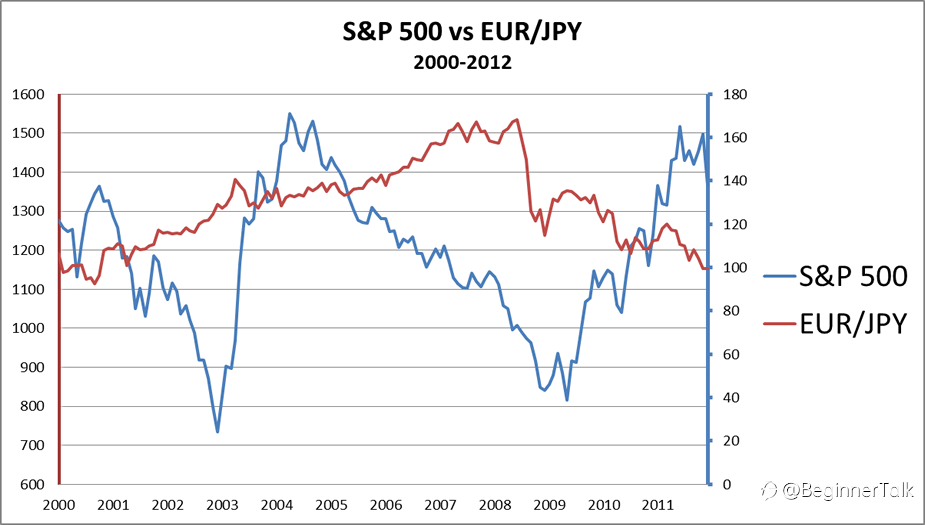
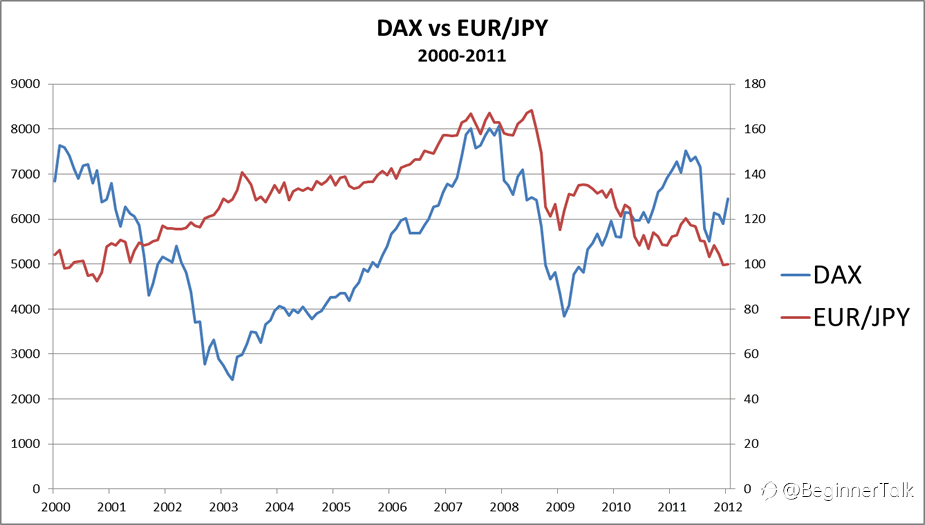
The correlation seems to have held well this past decade, as EUR/JPY and both indexes rose steadily together, until 2008 when we were hit with the Grear Financial Crisis (GFC).
In late 2007, EUR/JPY had hit its peak, and so did the stock indexes.
Reprinted from Babypips, the copyright all reserved by the original author.
면책 조항: 본 게시글에 표현된 견해는 전적으로 작성자의 견해이며 Followme의 공식 입장을 대변하지 않습니다. Followme는 제공된 정보의 정확성, 완전성 또는 신뢰성에 대해 책임을 지지 않으며, 서면으로 명시적으로 언급되지 않는 한 해당 내용을 기반으로 취해진 어떠한 조치에 대해서도 책임을 지지 않습니다.

