


| Scenario | |
|---|---|
| Timeframe | Weekly |
| Recommendation | BUY STOP |
| Entry Point | 0.6655 |
| Take Profit | 0.6713, 0.6774, 0.6835 |
| Stop Loss | 0.6610 |
| Key Levels | 0.6469, 0.6510, 0.6573, 0.6652, 0.6713, 0.6774, 0.6835 |
| Alternative scenario | |
|---|---|
| Recommendation | SELL STOP |
| Entry Point | 0.6570 |
| Take Profit | 0.6510, 0.6469 |
| Stop Loss | 0.6625 |
| Key Levels | 0.6469, 0.6510, 0.6573, 0.6652, 0.6713, 0.6774, 0.6835 |
Current trend
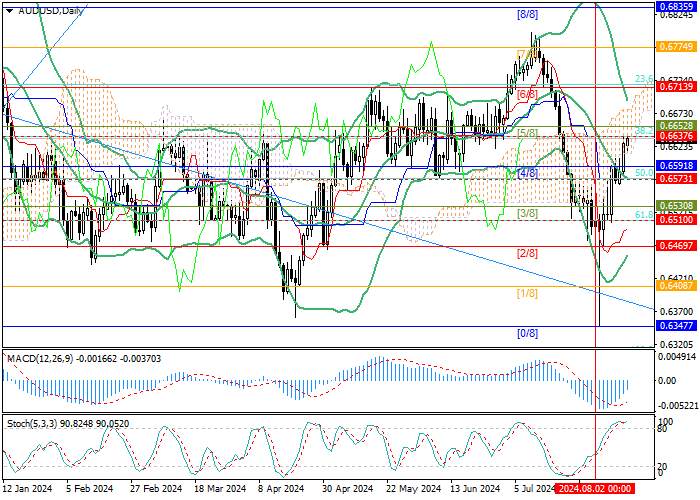
The AUD/USD pair has been recovering for the second week after reaching a year low of 0.6350 amid growing fears of a recession in the US economy. Currently, monetary factors have come to the forefront, contributing to the resumption of the upward dynamics. The US Fed may switch to a “dovish” course soon, while the cost of borrowing at the Reserve Bank of Australia (RBA) is likely to remain at previous levels for a long time.
Yesterday, US data on wholesale inflation for July were published, confirming a decrease in pressure in the economy. The producer price index fell from 0.2% to 0.1% MoM and from 2.7% to 2.2% YoY, while the core indicator adjusted from 0.3% to 0.0% and from 3.0% to 2.4%, respectively. If the July CPI, due out today at 14:00 (GMT 2), lives up to expectations of holding the figure steady at 3.0% and cutting the core indicator from 3.3% to 3.2%, then policymakers will have every reason to adjust the interest rate in September by –50 basis points.
The conditions for easing monetary policy in the Australian economy have not yet been created. The Q2 inflation reached 3.8%, moving away from the RBA’s target range of 2.0–3.0% but wage growth remained at 4.1%, reflecting the likelihood of further increases in consumer prices. In this situation, the regulator is unlikely to begin adjusting borrowing costs before the end of the year. In recent comments, the regulator’s head Michelle Bullock, and her deputy Andrew Houser said they were considering a switch to “hawkish” rhetoric if necessary.
Support and resistance
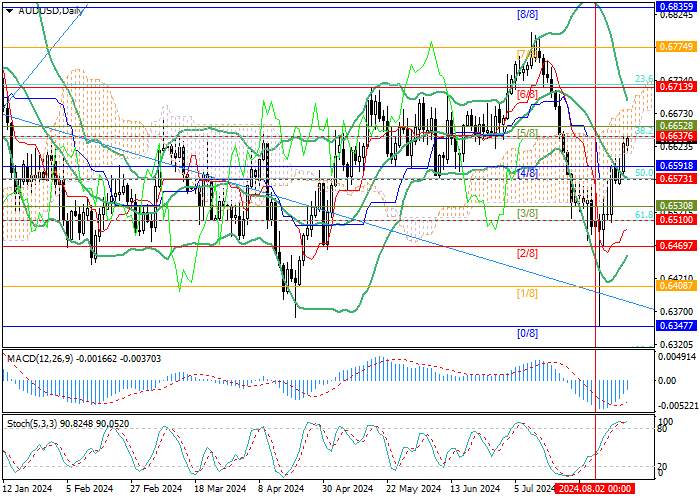
The trading instrument is approaching the resistance zone of 0.6637–0.6652 (Fibonacci correction 38.2%, Murrey level [5/8]). Its breakout may cause growth to the area of 0.6713 (Murrey level [6/8], Fibonacci correction 23.6%), 0.6774 (Murrey level [7/8]), and 0.6835 (Murrey level [8/8]). In case of a breakdown of 0.6573 (Fibonacci correction 50.0%), supported by the middle line of Bollinger Bands, the price may reach the area of 0.6510 (Fibonacci correction 61.8%) and 0.6469 (Murrey level [2/8]).
Technical indicators do not give a single signal: Bollinger Bands are downwards, and Stochastic is upwards, although it is entering the overbought zone, while the MACD histogram is preparing to move into the positive zone.
Resistance levels: 0.6652, 0.6713, 0.6774, 0.6835.
Support levels: 0.6573, 0.6510, 0.6469.
Trading tips
Long positions may be opened above 0.6652, with the targets of 0.6713, 0.6774, 0.6835 and stop loss of 0.6610. Implementation period: 5–7 days.
Short positions may be opened below 0.6573, with the targets of 0.6510, 0.6469 and stop loss of 0.6625.
면책 조항: 본 게시글에 표현된 견해는 전적으로 작성자의 견해이며 Followme의 공식 입장을 대변하지 않습니다. Followme는 제공된 정보의 정확성, 완전성 또는 신뢰성에 대해 책임을 지지 않으며, 서면으로 명시적으로 언급되지 않는 한 해당 내용을 기반으로 취해진 어떠한 조치에 대해서도 책임을 지지 않습니다.

더 오래된 의견은 없습니다. 소파를 가장 먼저 잡으십시오.