


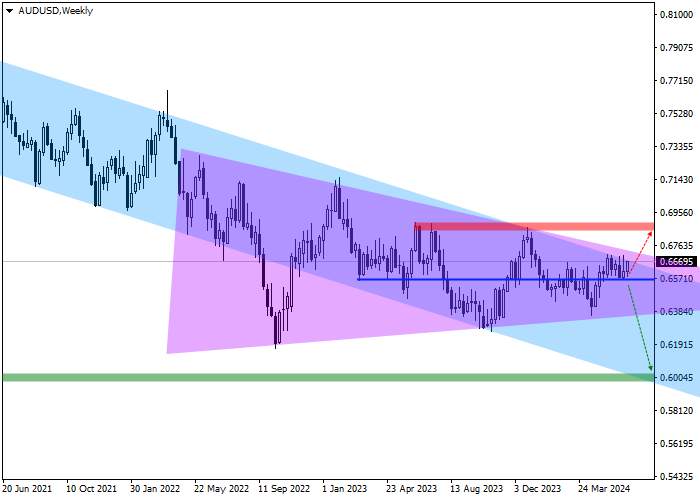
Today, we present you a mid-term investment overview of the AUD/USD pair.
During the monetary policy meeting on Tuesday, the Reserve Bank of Australia (RBA) kept the interest rate at 4.35% for the fifth time in a row in order to slow down inflation. Nevertheless, according to the report for the first quarter, it remains at a fairly high level: the consumer price index (CPI) amounted to 3.6% YoY, down from 4.1% earlier. Labor market indicators also remain negative: according to the report for May, the unemployment rate was 4.0%, slightly falling from 4.1% earlier due to a correction of full employment by 41.7 thousand with a projected growth of 30.5 thousand. In addition, the report on Australia's gross domestic product (GDP) for Q1 2024 reflected growth of 0.1%, which is lower by 0.3% a quarter earlier, and YoY it slowed from 1.6% to 1.1%.
The main factor in the dynamics of the trading instrument remains the American currency, which has recently been held around 105.0 points in the USDX. The stability of the dollar is ensured by the position of the US Federal Reserve, which has been keeping interest rates within 5.25–5.50% for a very long time. A reduction in the cost of borrowing is unlikely to occur before the end of summer: according to the Chicago Mercantile Exchange (CME) FedWatch Tool, the probability of a reduction in interest rates at the July meeting is only 12.4%. Also recently, relative stability in the labor and real estate markets can be noted: according to the latest report, new home sales in the United States in January amounted to 634.0 thousand, and the total number of people receiving unemployment benefits last week amounted to 1.820 million people, which is significantly lower than the average value of the beginning of spring at 1.900 million people.
In addition to the underlying fundamental factors, the continuation of the decline in the AUD/USD pair is confirmed by technical indicators: on the W1 chart, the price moves within the next descending wave inside the descending corridor with the boundaries of 0.6700–0.6000.
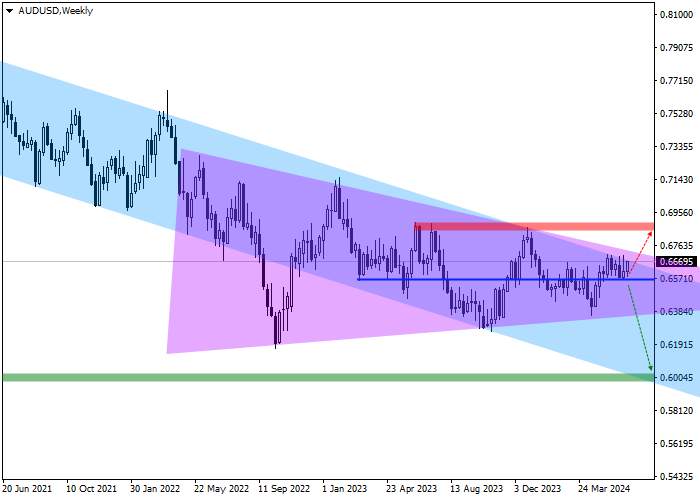
After reflecting off the 0.6680 resistance line, the price has not yet received the necessary confirmation for a reversal, and the most likely scenario looks like a move towards the 0.6000 support line.
Key levels can be seen on the D1 chart.
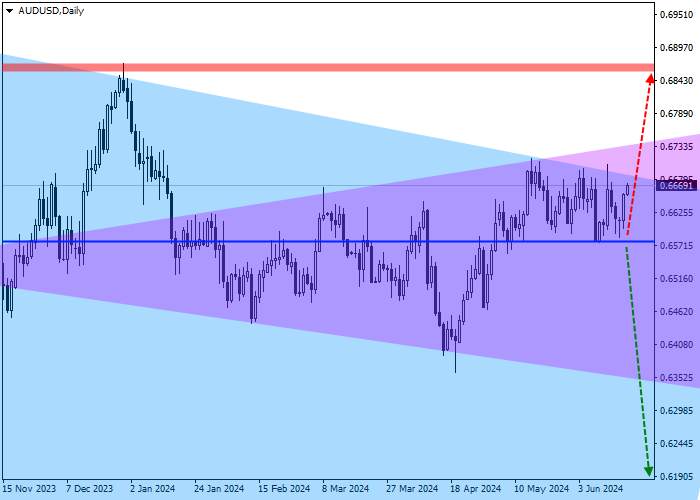
As can be seen on the chart, the price continued to implement the corrective pattern "expanding formation", the resistance line of which has already been repeatedly reached by the instrument at 0.6700, and is now preparing to form a reversal.
In the area of the 0.6870 mark, which coincides with the maximum of December 28, there is a zone of global cancellation of the sell signal; if it is reached, the downward scenario will be canceled or significantly delayed in time, and the sell positions should be eliminated.
At the level of 0.6000, which coincides with the support level of the descending channel, there is a target zone; if it is reached, profit should be taken on open sell positions.
In more detail, trade entry levels can be evaluated on the H4 chart.
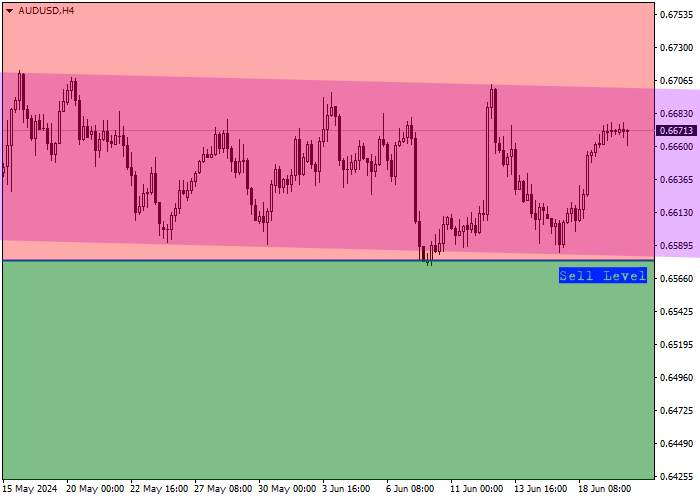
The entry level to sell deals is located at 0.6575, and a local signal can be received as early as this week. Technically, overcoming the local minimum of the beginning of June and consolidating below the support level will be implemented; after the breakdown of this level, the necessary confirmation will be formed to open local sell positions.
Given the average daily volatility of the trading instrument over the past month, which is 36.7 points, the price movement to the target zone of 0.6000 may take about 48 trading sessions; however, with increased dynamics, this time may be reduced to 39 trading days.
면책 조항: 본 게시글에 표현된 견해는 전적으로 작성자의 견해이며 Followme의 공식 입장을 대변하지 않습니다. Followme는 제공된 정보의 정확성, 완전성 또는 신뢰성에 대해 책임을 지지 않으며, 서면으로 명시적으로 언급되지 않는 한 해당 내용을 기반으로 취해진 어떠한 조치에 대해서도 책임을 지지 않습니다.

더 오래된 의견은 없습니다. 소파를 가장 먼저 잡으십시오.