


The first thing you’re going to learn is how to calculate pivot point levels.
The pivot point and associated support and resistance levels are calculated by using the last trading session’s open, high, low, and close.
Since forex is a 24-hour market, most forex traders use the New York closing time of 5:00 pm EST as the previous day’s close.
Pivot Point Calculation
The calculation for a pivot point is shown below:
Pivot point (PP) = (High + Low + Close) / 3
Support and resistance levels are then calculated off the pivot point like so:
First level support and resistance:
First resistance (R1) = (2 x PP) – Low
First support (S1) = (2 x PP) – High
Second level of support and resistance:
Second resistance (R2) = PP + (High – Low)
Second support (S2) = PP – (High – Low)
Third level of support and resistance:
Third resistance (R3) = High + 2(PP – Low)
Third support (S3) = Low – 2(High – PP)
Keep in mind that some forex charting software plots intermediate levels or mid-point levels.
These are basically mini levels between the main pivot point and support and resistance levels.
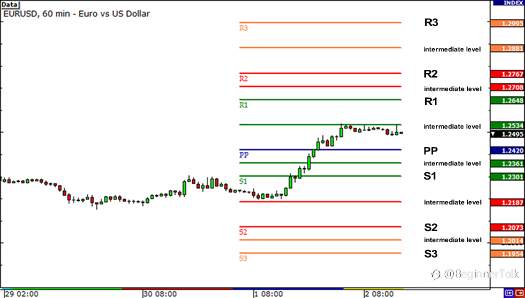
If you hated algebra, have no fear because you don’t have to perform these calculations yourself.
Most charting software will automatically do this for you. Just make sure you configure your settings so that it uses the correct closing time and price.
Remember, one of the advantages of using pivot points is that it is objective, so it’s very easy to test how prices react to them.
Next up, we’ll teach you the various ways in which you can incorporate pivot points into your forex trading strategy.
Reprinted from Babypips,the copyright all reserved by the original author.
면책 조항: 본 게시글에 표현된 견해는 전적으로 작성자의 견해이며 Followme의 공식 입장을 대변하지 않습니다. Followme는 제공된 정보의 정확성, 완전성 또는 신뢰성에 대해 책임을 지지 않으며, 서면으로 명시적으로 언급되지 않는 한 해당 내용을 기반으로 취해진 어떠한 조치에 대해서도 책임을 지지 않습니다.

더 오래된 의견은 없습니다. 소파를 가장 먼저 잡으십시오.