


Similar to rectangles, pennants are continuation chart patterns formed after strong moves.
After a big upward or downward move, buyers or sellers usually pause to catch their breath before taking the pair further in the same direction.
Because of this, the price usually consolidates and forms a tiny symmetrical triangle, which is called a pennant.
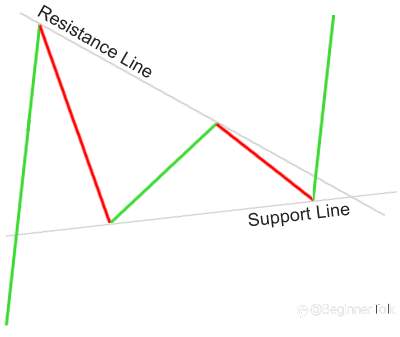
While the price is still consolidating, more buyers or sellers usually decide to jump in on the strong move, forcing the price to bust out of the pennant formation.
Bearish Pennants
A bearish pennant is formed during a steep, almost vertical, downtrend.
After that sharp drop in price, some sellers close their positions while other sellers decide to join the trend, making the price consolidate for a bit.
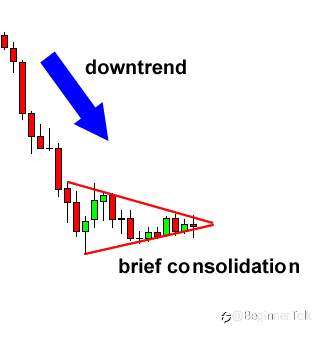
As soon as enough sellers jump in, the price breaks below the bottom of the pennant and continues to move down.
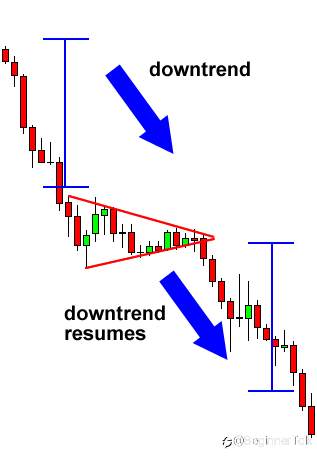
As you can see, the drop resumed after the price made a breakout to the bottom.
To trade this chart pattern, we’d put a short order at the bottom of the pennant with a stop loss above the pennant.
That way, we’d be out of the trade right away in case the breakdown was a fakeout.
Unlike the other chart patterns wherein the size of the next move is approximately the height of the formation, pennants signal much stronger moves.
Usually, the height of the earlier move (also known as the mast) is used to estimate the size of the breakout move.
Bullish Pennant
Bullish pennants, just like its name suggests, signals that bulls are about to go a-chargin’ again.
This means that the sharp climb in price would resume after that brief period of consolidation when bulls gather enough energy to take the price higher again.
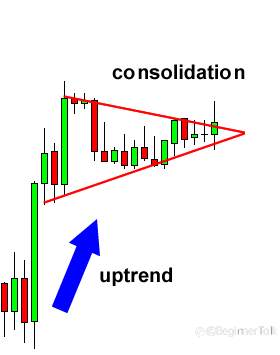
In this example, the price made a sharp vertical climb before taking a breather. I can hear the bulls stomping and revving up for another run!
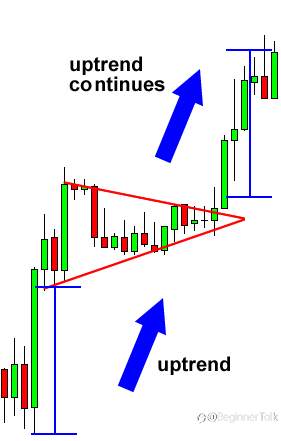
Just like we predicted, the price made another strong move upwards after the breakout.
To play this, we’d place our long order above the pennant and our stop below the bottom of the pennant to avoid fakeouts.
Like we discussed earlier, the size of the breakout move is around the height of the mast (or the size of the earlier move).
You see, pennants may be small in size but they could signal huge price moves so don’t underestimate ’em!
Reprinted from Babypips,the copyright all reserved by the original author.
면책 조항: 본 게시글에 표현된 견해는 전적으로 작성자의 견해이며 Followme의 공식 입장을 대변하지 않습니다. Followme는 제공된 정보의 정확성, 완전성 또는 신뢰성에 대해 책임을 지지 않으며, 서면으로 명시적으로 언급되지 않는 한 해당 내용을 기반으로 취해진 어떠한 조치에 대해서도 책임을 지지 않습니다.

더 오래된 의견은 없습니다. 소파를 가장 먼저 잡으십시오.