

If we take this trend line theory one step further and draw a parallel line at the same angle of the uptrend or downtrend, we will have created a channel.
No, we’re not talking about ESPN, National Geographic Channel, or Cartoon Network.
These channels aren’t television channels, they’re trend channels, sometimes also called price channels.
Still, this doesn’t mean that you should walk away like it’s a commercial break. Channels can be just as exciting to watch as Tiger King or Keeping Up with the Kardashians!Trend channels are just another tool in technical analysis which can be used to determine good places to buy or sell.
The upper trend line marks resistance and the lower trend line marks support. So both the tops and bottoms of channels represent potential areas of support or resistance.
Trend channels with a negative slope (down) are considered bearish and those with a positive slope (up) are considered bullish.
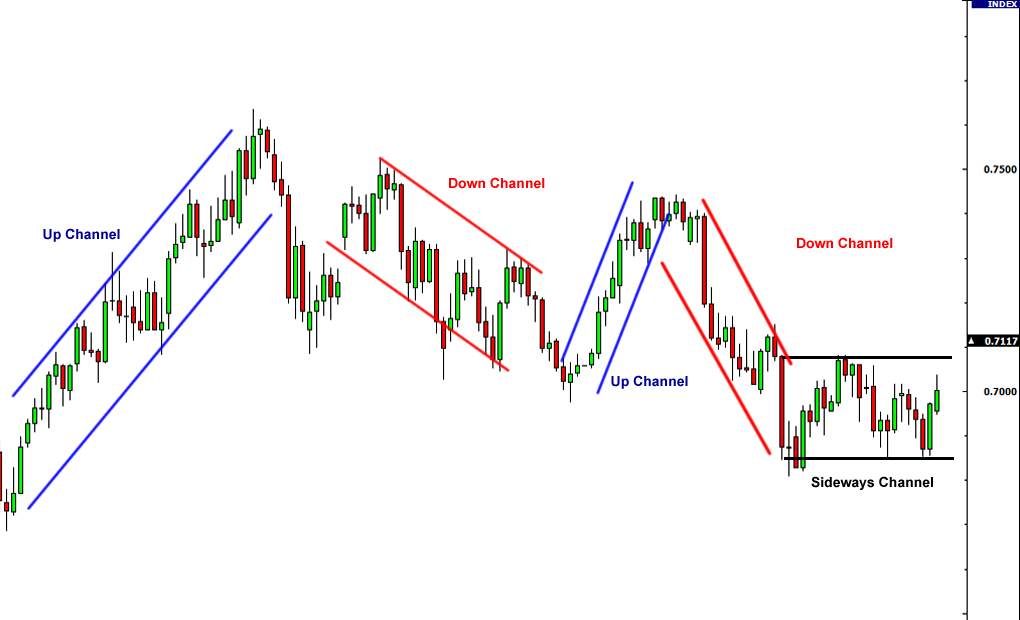
To create an up (ascending) channel, simply draw a parallel line at the same angle as an uptrend line and then move that line to position where it touches the most recent peak. This should be done at the same time you create the trend line.
To create a down (descending) channel, simply draw a parallel line at the same angle as the downtrend line and then move that line to a position where it touches the most recent valley. This should be done at the same time you create the trend line.When prices hit the LOWER trend line, this may be used as a buying area.
When prices hit the UPPER trend line, this may be used as a selling area.
Types of Trend Channels
There are three types of channels:
- Ascending channel (higher highs and higher lows)
- Descending channel (lower highs and lower lows)
- Horizontal channel (ranging)
Some traders prefer to use the terms “rising channel” for an ascending channel and “falling channel” for a descending channel. Most likely, Millenials.
Important things to remember about drawing trend channels:
When constructing a trend channel, both trend lines must be parallel to each other.
Generally, the bottom of the trend channel is considered a “buy zone” while the top of the trend channel is considered a “sell zone”.Like in drawing trend lines, DO NOT EVER force the price to the channels that you draw!
A channel boundary that is sloping at one angle while the corresponding channel boundary is sloping at a different angle is not correct and could lead to bad trades.
When this happens, this chart pattern is no longer a trend channel but a triangle. (which you will learn about more later).
That said, trend channels don’t have to be completely parallel. Nor does 100% of price action have to fit within the channel.
A common mistake many traders make is that they only look for textbook price patterns.
They miss important information about price action and close their eyes to other important clues.
Notice the channel drawings below…
Do they look perfect? 👀
Waiting for picture-perfect textbook examples won’t help you in the real world because it’s going to be pretty rare to see price action that fits perfectly within two perfectly parallel trend lines.
Reprinted from Babypips, the copyright all reserved by the original author.
면책 조항: 본 게시글에 표현된 견해는 전적으로 작성자의 견해이며 Followme의 공식 입장을 대변하지 않습니다. Followme는 제공된 정보의 정확성, 완전성 또는 신뢰성에 대해 책임을 지지 않으며, 서면으로 명시적으로 언급되지 않는 한 해당 내용을 기반으로 취해진 어떠한 조치에 대해서도 책임을 지지 않습니다.

더 오래된 의견은 없습니다. 소파를 가장 먼저 잡으십시오.