


2020 has apparently been the year of privacy wallets, as more exchanges onboard KYC requirements.
 Photo: Cointelegraph
Elliptic, a leading firm in blockchain analytics, has found major shifts in recent trends in illicit crypto use.
Per the firm's study released Wednesday, the proportion of Bitcoin (BTC) transactions that the firm has linked to criminal activity is way down, certainly relative to its 2012 peak:
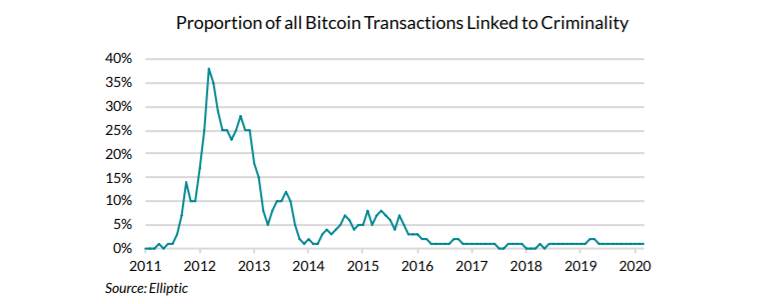
Photo: Cointelegraph
Tom Robinson, Elliptic's chief scientist, explained to Cointelegraph that this is the result of many trends in crypto. These included heightened exchange compliance and law enforcement activity, as well as the growing force of analytics firms like Elliptic itself. Interestingly, Robinson also said general use has simply exploded:
"Other crypto use-cases have exploded in popularity — most notable speculation. The majority of crypto is simply being sent between exchanges. The value of those transactions dwarfs anything related to crime."
Nonetheless, bad actors continue finding new ways of placing ill-gotten gains via crypto. Elliptic noted a slight rise in crypto mixing use but a major increase in privacy wallets:
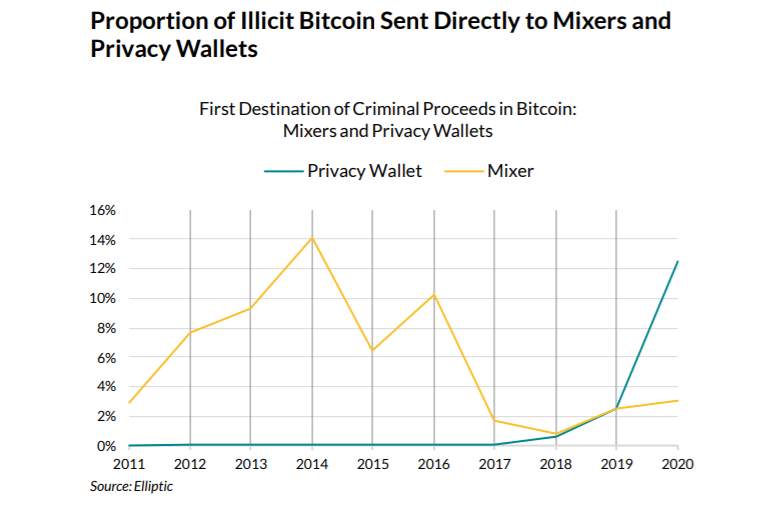
Photo: Cointelegraph
Increasing legal pressure and criminal charges on operators may have changed dependence on mixers over the years. This is also likely thanks to firms like Elliptic, or competitors Cyphertrace and Chainalysis, which have gotten good at tracking coins through mixers.
Facing heightened Know Your Customer requirements globally, exchanges have also lost ground as a destination for illegal crypto.
Privacy wallets, however, have skyrocketed. Elliptic's David Carlisle said, “The most significant trend we observed was the increasing use of privacy wallets such as Wasabi Wallet in the laundering process. In 2020 at least 13% of all criminal proceeds in Bitcoin were sent through privacy wallets, which is up from just 2% in 2019.”
However, Elliptic has a limited range of knowledge over the origins, criminal or otherwise, of funds going through these privacy wallets. In response to a question as to how Elliptic knows if Bitcoin going through a Wasabi Wallet is linked to illegal activity, Tom Robinson told Cointelegraph: "In general, we can't — we can see what's going in and what's coming out, but we can't link the two together."
Wasabi, for its part, has faced questions over the durability of its privacy features in the past. It seems that they at the very least pose a barrier to analytics firms.
Reprinted from Cointelegraph, the copyright all reserved by the original author.
면책 조항: 본 게시글에 표현된 견해는 전적으로 작성자의 견해이며 Followme의 공식 입장을 대변하지 않습니다. Followme는 제공된 정보의 정확성, 완전성 또는 신뢰성에 대해 책임을 지지 않으며, 서면으로 명시적으로 언급되지 않는 한 해당 내용을 기반으로 취해진 어떠한 조치에 대해서도 책임을 지지 않습니다.

더 오래된 의견은 없습니다. 소파를 가장 먼저 잡으십시오.