


$50 Free Margin Account Campaign:
https://www.nooralmal.com/cc19...
EURUSD
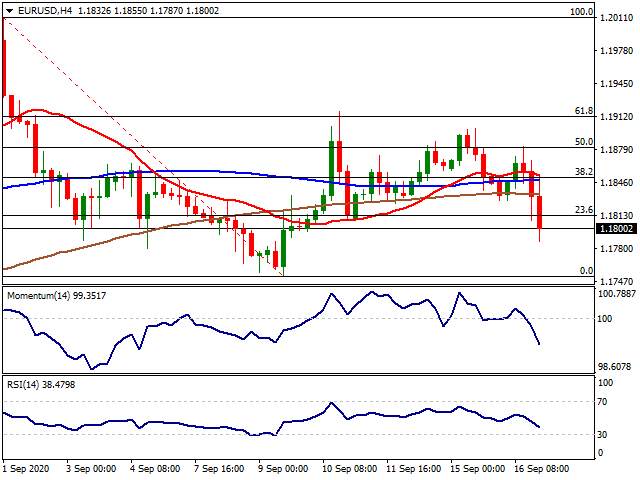
The dollar traded with a sour tone throughout the first half of the day, but the EUR/USD pair held below 1.1900. The pair retreated from an intraday high of 1.1882 following the release of dismal US data and in anticipation of the US Federal Reserve announcement. Retail sales gained 0.6% in August, while the core reading, Retail Sales Control Group, contracted -0.1%, missing expectations of 0.5%. The tepid numbers anticipate more easing for longer, with equities reaching weekly highs.
Then came the Fed. As expected, the central bank left its monetary policy unchanged, including in the statement, the latest framework shift to an average inflation target. Fresh forecasts showed that the FOMC expects the GDP to contract by 3.7% at a softer pace than the previous forecast of 6.5% in 2020 and sees unemployment at 7.6% at year's end, compared to 9.3% in June projection. Fed fund rates are seen unchanged for this year and the next ones, while inflation was downwardly revised for this year to 1.0% from 1.5%. The central bank had a limited impact on currencies, as the dollar seesawed within familiar levels through the event.
This Thursday, the EU will publish the final reading of August inflation, while the US will release housing data for August, and Initial Jobless Claims for the week ended September 11.
The EUR/USD pair fell below 1.1800, with the shared currency weakening at a faster pace against the greenback that other major rivals. The pair turned bearish in the short-term, as the 4-hour chart shows that it’s now developing well below all of its moving averages, which anyway remain confined to a tight range. Technical indicators, in the meantime, are firmly bearish within negative levels, supporting a test of the low set this month at 1.1752.
Support levels: 1.1750 1.1710 1.1665
Resistance levels: 1.1880 1.1915 1.1960
USDJPY
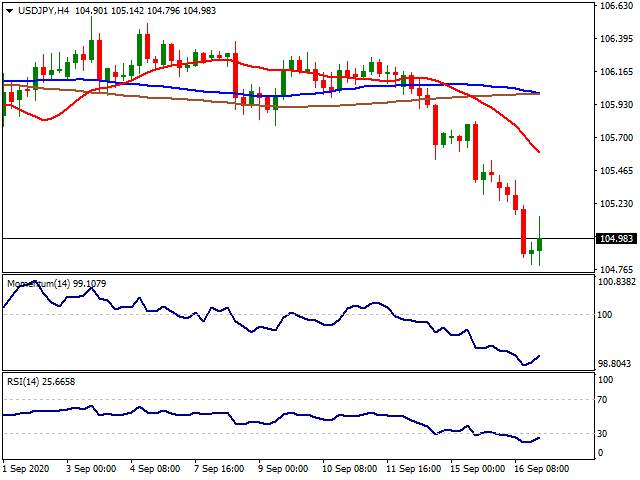
The USD/JPY pair lost the 105.00 level, falling to a fresh monthly low of 104.79. The pair was already falling on the back of the broad dollar’s weakness, extending its slump after the release of dismal US Retail Sales figures. The US Federal Reserve had a limited impact on the pair, as it is heading into the Asian opening trading around the 105.00 level, finding some support during US trading hours in an uptick in Treasury yields. US equities, however, ended the day mixed, with only the DJIA able to retain early gains.
Meanwhile, Yoshihide Suga has been confirmed by the Japanese Parliament as the new Prime Minister of the country. He is expected to follow Abe’s path, and that should keep the waters calm, at least from that front.
The Bank of Japan is having a monetary policy meeting this Thursday, and it is largely anticipated to maintain its current monetary policy unchanged, with the main rate at -0.10% and the focus on keeping the yield-curve under control. Policymakers may revise their economic outlooks, but even with an upgrade of growth and inflation figures, the event has little chances of having a significant impact in the JPY.
The USD/JPY pair is still bearish and could extend its slump once below 104.70, now the immediate support. The 4-hour chart shows that it keeps trading well below a firmly bearish 20 SMA, which extends its decline below the larger ones. Technical indicators, in the meantime, have managed to post modest recoveries from daily lows, but remain within oversold levels, maintaining the risk skewed to the downside, poised to break below 104.18, July monthly low.
Support levels: 104.70 104.40 104.00
Resistance levels: 105.15 105.50 105.90
GBPUSD
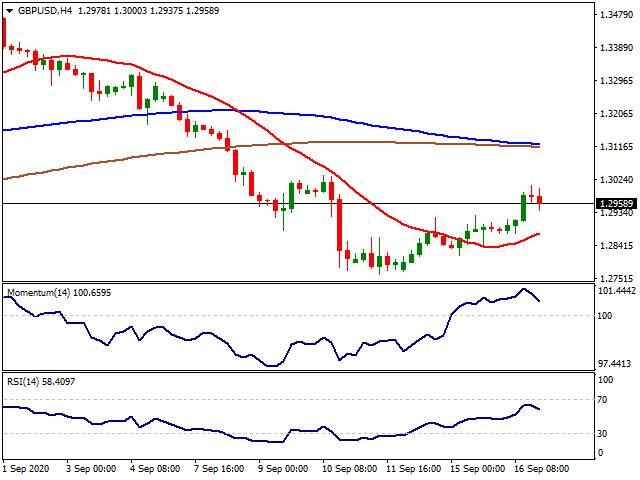
The GBP/USD pair neared the 1.3000 figure, soaring on reports the UK offered tentative concessions on fisheries in trade talks with the EU, one of the main issues blocking negotiations in the last months. The market ignored UK mixed inflation-related data, although August annual CPI improved to 0.2%. The Producer Price index in the same period, however, fell 0.9%, while the Retail Price index increased 0.5% against the 0.6% expected and the previous 1.6%.
This Thursday, the focus will be on the Bank of England, as the central bank will unveil its latest monetary policy decision. Policymakers are not expected to change their current monetary policy, keeping rates at record lows of 0.1%. However, there’s mounting speculation that the central bank will introduce additional stimulus before year-end. Probably not this time, but anyway, speculative interest will be scrutinizing Bailey’s comments for any hint on the issue.
The GBP/USD pair traded around 1.2960 ahead of Fed’s announcement and stands in the same area as the day comes to an end. The 4-hour chart shows that the pair has further advanced above a now bullish 20 SMA, although it remains below the 100 and 200 SMA, both converging around 1.3110/20. Technical indicators eased from their intraday highs alongside price, but remain within positive levels. Overall, the risk of a steeper decline seems contained, mainly with positive Brexit developments.
Support levels: 1.2915 1.2860 1.2810
Resistance levels: 1.3000 1.3050 1.3095
AUDUSD
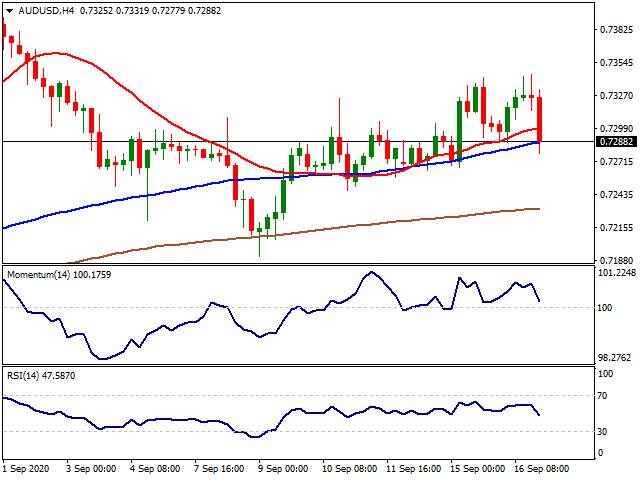
The AUD/USD pair hit a daily high of 0.7344 but is ending the day a handful of pips below the 0.7300 level, as the US Federal Reserve hinted no more stimulus coming in the near term. The comment affected gold prices, which in turn weighed on the Aussie. At the beginning of the day, Australia published the August Westpac leading Index, which improved from 0.05% to 0.48%. On a down note, HIA New Home Sales declined 14.4% in August, far below the 79.6% advance expected.
Australia will publish this Thursday its August employment data, and as anticipated last month, the latest lockdown in Victoria is expected to have taken its toll on employment. The market expects to see 50K jobs were lost in the month, while the unemployment rate is foreseen at 7.7% from 7.5% in July.
The AUD/USD pair retains its neutral stance in the short-term, as its ending a fifth consecutive day little changed. The 4-hour chart shows that its currently hovering around converging 20 and 100 SMA, while technical indicators have turned lower, now within neutral levels. The upside seems limited with the risk now skewed to the downside. A steeper decline seems likely on a break below 0.7250, the immediate support level.
Support levels: 0.7250 0.7215 0.7170
Resistance levels: 0.7310 0.7350 0.7385
GOLD
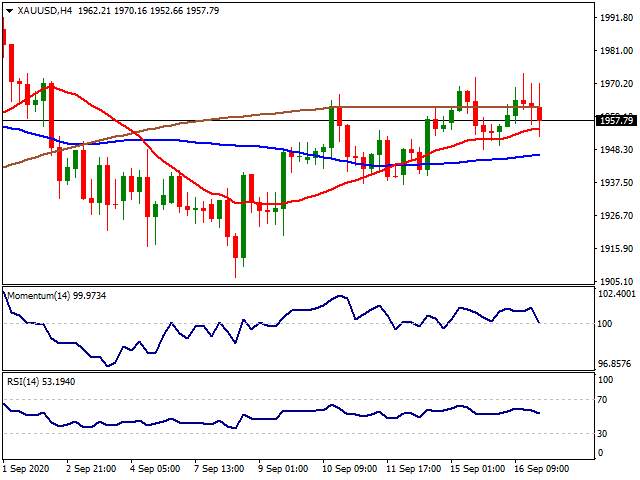
Gold hit a fresh two-week high at $1,973, but it turned to the downside. The short-term bias still points to the upside, but as the U.S. dollar's momentum intensifies and risk appetite eases, the road to more gains is not clear. The greenback rebounded after the FOMC meeting. The Fed signalled it would keep rates at extraordinarily low levels at least until the end of 2023. Despite the outlook presented by the U.S. central bank, the dollar and Treasury yields rose, weakening metals. On Thursday, data to be released includes U.S. jobless claims.
XAU/USD continues to be neutral to bullish in the short-term, as it set another higher high and higher low, but it finished the day pointing to the downside and near $1,950. A consolidation below would suggest a lower trading range between $1,950 and $1,935. A slide under $1,935 should lead to further weakness and could expose the key barrier at $1,900/05. If it holds above $,1950, XAU/USD should keep some strength. The resistance band at $1,970/75 is needed to clear the way to more gains.
Support Levels: $1,950 $1,937 $1,905
Resistance Levels: $1,978 $2,000 $2,015
SILVER
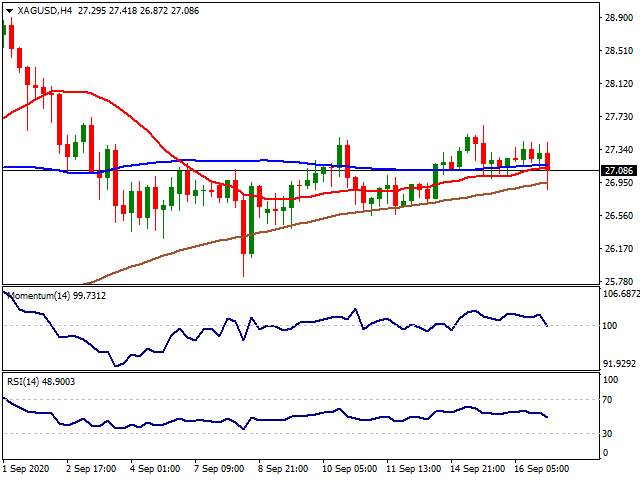
Silver dropped 0.25% on Wednesday while gold rose modestly. Despite posting gains, the yellow metal finished far from the top. A stronger U.S. dollar after the FOMC meeting affected metals that pulled back. The slide was more pronounced in silver that bottomed at $26.87, hitting a two day low. The next move in XAG/USD could be to the downside if the U.S. dollar stages a recovery, but if market participants take another consideration of Wednesday's dovish FOMC statement, it could rebound.
From a technical perspective, silver still looks neutral, but short-term risks are starting to move to the downside. On Wednesday it failed to rise above $27.45 and tested levels under $27.00, ending back below the 20-day moving average. A consolidation under $26.95 would signal more losses ahead and a close under $26.40 should expose $26.00 and the September low at $25.80. On the upside, XAG/USD needs to successfully move north of $27.20 to suggest it is ready to test the next resistance at $27.80.
Support Levels: $26.55 $26.00 $25.00
Resistance Levels: $27.45 $28.50 $29.15
CRUDE WTI
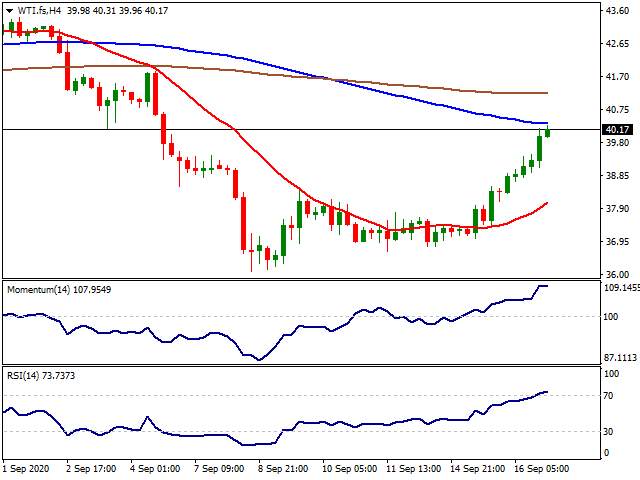
Crude oil prices rose for the fourth day in a row on Wednesday, extending the bounce off last week lows and claiming the $40 level, propelled by an unexpected drop in US oil inventories. The Energy Information Administration (EIA) reported that US crude stockpiles dropped by 4.4 million barrels last week, against estimations of a 1.3 million increase. In addition, Hurricane Sally forced the shutdown of more than 25% of oil production in the Gulf of Mexico.
WTI climbed more than 4% on Wednesday and hit a 12-day high of $40.31 a barrel. The price had struck a nearly three-month low of $36.10 last week, weighed by concerns of dwindling global demand on the back of the COVID-19 pandemic.
From a technical view, the technical bias remains bullish, although the RSI has already reached overbought readings in the 4-hour chart, favoring a period of consolidation before another leg higher. The immediate resistance area is delimited by the 20- and the 200-day SMAs, converging at the $40.40-50 zone. A breakout here could pave the way toward the $41.40 area first, en route to $41.80. On the other hand, short-term supports are seen at $38.40, daily low, and $37.70, 100-day SMA.
Support levels: $38.40 $37.70 $36.80
Resistance levels $40.50 $41.00 $41.40
DOW JONES
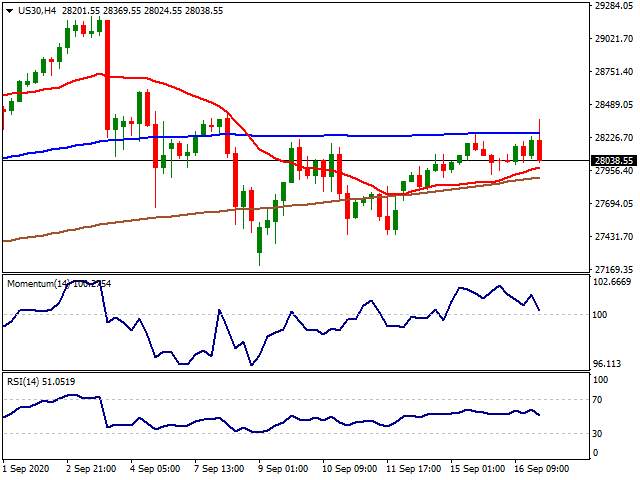
US stocks gains waned at the end of the trading session on Wednesday, after the Fed decided to maintain its policy rate unchanged but highlighted downside risks to the economy. The Dow Jones Industrial Average index gained 36 points, or 0.13%, to close at 28,132. It reached a session high of 28,364, but gave up most part of its daily advance. Still was the only one of the main indexes to close in the green. The S&P 500 index lost 15 points, or 0.46%, to close at 3,385. The Nasdaq Composite index dropped 139 points, or 1.25%, to finish at 11,050.
The DJIA technical perspective remains slightly positive, although indicators are losing bullish momentum. Still, the 100- and 200-day SMAs have completed a bullish cross at the 26,295 area, supporting the set-up. Still, failure to close above 28,200 could be a negative sign. The index needs a clear break above that level to pave the way toward the next upside target at 28,735, August monthly high, en-route to 29,200, September 3 high. On the other hand, short-term supports remain at 27,400 and 27,000. The upside would remain favored as long as the DJIA holds above the 200-day SMA, currently at the 26,300 zone.
Support Levels: 27,400 27,000 26,300
Resistance Levels: 28,200 28,750 29,200
MACROECONOMIC EVENTS
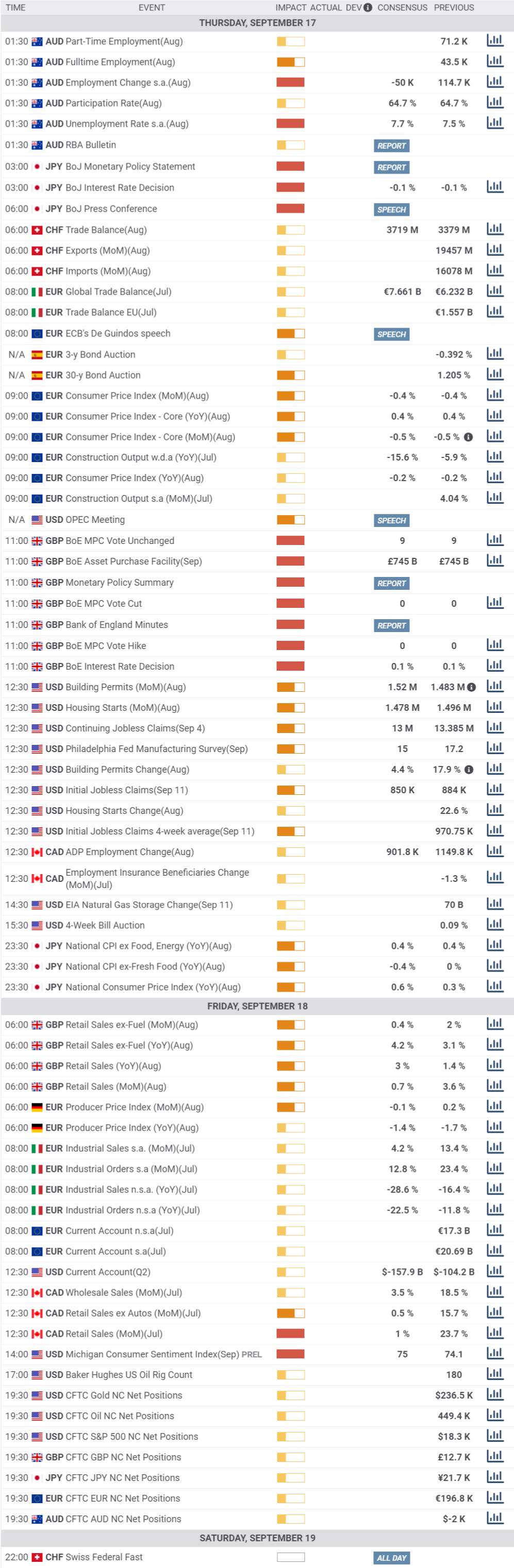
* All the Moving Average support and resistance levels are dynamic by nature. Means when the price approaches the Moving averages, slight variation occurs in the forecasted Moving Average support and resistance levels. Previous few days’ intraday levels are also signicant while trading the current day as the price tend to hover around these levels for some time. Levels in red indicate strong, critical or vital.
Please remember that trading financial markets carry a high degree of risk to your capital. It is possible to lose more than your initial stake. Leveraged products may not be suitable for all investors, therefore please ensure you fully understand the risks involved and seek independent advice if necessary.
All Rights Reserved © Noor Al Mal
#9月美联储决议暗示长期低利率##TikTok不卖了##欧央行决议按兵不动##无协议脱欧风险又来##美股狂飙要到头了吗#
면책 조항: 본 게시글에 표현된 견해는 전적으로 작성자의 견해이며 Followme의 공식 입장을 대변하지 않습니다. Followme는 제공된 정보의 정확성, 완전성 또는 신뢰성에 대해 책임을 지지 않으며, 서면으로 명시적으로 언급되지 않는 한 해당 내용을 기반으로 취해진 어떠한 조치에 대해서도 책임을 지지 않습니다.

더 오래된 의견은 없습니다. 소파를 가장 먼저 잡으십시오.