


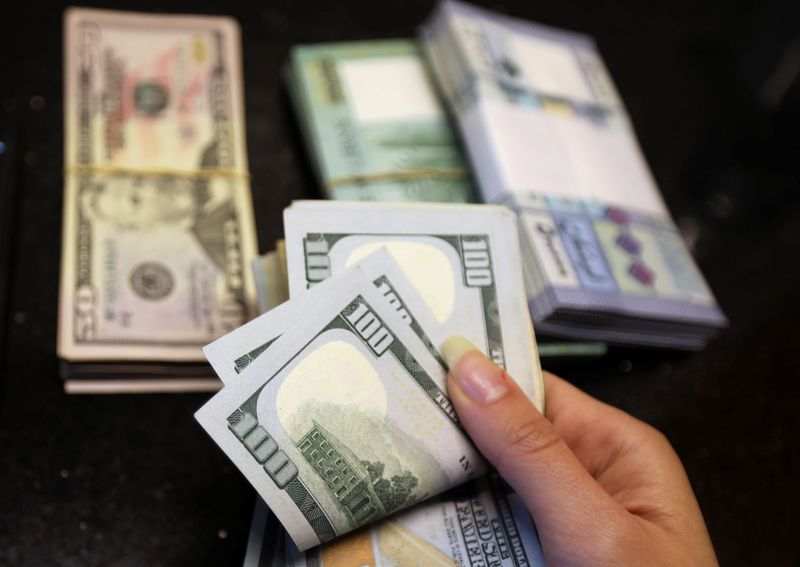
 © Reuters. A woman counts U.S. dollar banknotes at a currency exchange shop in Beirut
By Hideyuki Sano
TOKYO (Reuters) - The dollar slipped to two-year lows on Friday and is on track to post its biggest monthly decline in 10 years, as investors worried that a recovery in the U.S. economy could be stymied by the second wave of coronavirus.
Confidence in the U.S. currency was undermined further after U.S. President Donald Trump raised the possibility of delaying the nation's November presidential election.
The dollar index fell to 92.777 (=USD), and is on course to post its biggest monthly fall in 10 years.
"At the root of the dollar's weakness is the fact, which was highlighted by Fed Chairman (Jerome) Powell the other day, that U.S. coronavirus cases started to increase in mid-June, curbing consumption and sending the economy downhill," said Daisuke Uno, chief strategist at Sumitomo Mitsui (NYSE:SMFG) Bank.
The U.S. Labor Department data showed initial claims for unemployment benefits increased 12,000 to a seasonally adjusted 1.434 million in the week ending July 25, a sign that recovery in the employment market is stalling.
That poured cold water on hopes of recovery after a devastating recession in the previous quarter. Data on Thursday showed that the U.S. economy contracted by 32.9% in the second quarter, the steepest pace since the Great Depression.
The U.S. Congress was no closer to a deal extending or replacing the extra $600-per-week in payments to tens of millions thrown out of work by the coronavirus pandemic, just one day before a federal jobless benefit was set to expire.
Adding salt to the dollar's injury, Trump raised the idea of delaying the Nov. 3 U.S. elections, although it was immediately rejected by both Democrats and his fellow Republicans in Congress - the sole branch of government with the authority to make such a change.
"The mere suggestion by Trump of a delay does play to concerns that the election result will be challenged in November (should Trump lose), and that, because of the likely larger than usual share of votes via mail in ballots due to the pandemic, we might not now (get) the result on election night itself," wrote Ray Attrill, Head of FX Strategy at National Australia Bank (OTC:NABZY) in Sydney.
Leading the charge against the dollar was the euro, which has gained traction after European Union leaders agreed this month to a 750 billion euro economic recovery fund, taking on debt jointly in a major boost to regional cooperation.
The euro hit a two-year high of $1.1889 and last traded at $1.1869 (EUR=), having gained 5.7% so far in July, also the biggest gain in a decade.
Against the yen, the dollar hit a 4 1/2-month low of 104.52 yen and last stood at 104.54 <jpy=>, having lost 3.1% this month.</jpy=>
Likewise the British pound stood at $1.3119 <gbp=d4>after hitting a 4 1/2-month high of $1.3136.</gbp=d4>
Reprinted from investing.com, the copyright all reserved by the original author.
면책 조항: 본 게시글에 표현된 견해는 전적으로 작성자의 견해이며 Followme의 공식 입장을 대변하지 않습니다. Followme는 제공된 정보의 정확성, 완전성 또는 신뢰성에 대해 책임을 지지 않으며, 서면으로 명시적으로 언급되지 않는 한 해당 내용을 기반으로 취해진 어떠한 조치에 대해서도 책임을 지지 않습니다.

더 오래된 의견은 없습니다. 소파를 가장 먼저 잡으십시오.