


Australia on Thursday announced that its budget deficit is expected to deepen significantly as it battles a coronavirus outbreak that ended the economy’s nearly three-decade growth streak — one of the longest seen in any country around the world.
The country’s budget deficit is forecast to deepen significantly to 85.8 billion Australian dollars ($61.27 billion) in the financial year that just ended on June 30 from a balanced fiscal position in the prior year, according to a joint statement by the Australian treasurer and finance minister.
That shortfall is projected to widen even more to 184.5 billion Australian dollars ($131.78 billion) in the new fiscal year, the statement said. A Reuters report said that would be the country’s biggest deficit since World War II.
Speaking to CNBC’s “Street Signs Asia” after the release of the statement, Australian Finance Minister Mathias Cormann described the numbers as “challenging.” In addition to the budget forecasts, the statement also contains the government’s projections for growth, debt levels and employment situation.
“We know why we’re here. We know that these numbers are the result overwhelmingly of the impact on our economy (by) the coronavirus pandemic,” he said.
The Australian government has announced fiscal stimulus worth 289 billion Australian dollars ($206.54 billion) to support workers, households and businesses managing the economic fallout of the pandemic. That’s equivalent to around 14.6% of the country’s gross domestic product.
That additional spending is expected to cause a significant increase in the country’s debt levels, according to the joint statement. Still, Cormann said Australia’s current financial position is better and stronger than most countries.
“The truth is ... yes we’ve had to spend a lot of money, we had to incur crisis-level temporary expenditure, we’re only committing expenditure for this purpose over a two-year period,” he said.
“Even after all of this additional expenditure, our debt levels are still lower than the debt levels of many other countries before they went into the coronavirus period. So, we do have fiscal capacity to continue to respond,” the minister added.
But even with the government’s support, the Australian economy is forecast to shrink by 3.75% this year before growing by around 2.5% next year, read the statement.
Nicki Hutley, a partner at Deloitte Access Economics, said the trajectory of the Australian economy depends to a large extent on how the domestic coronavirus outbreak turns out.
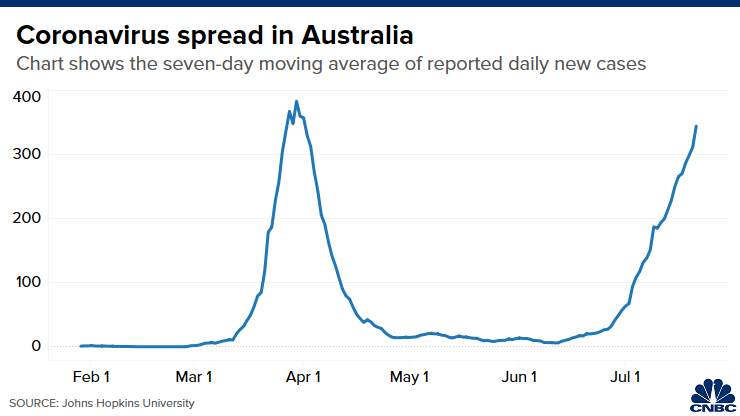
The country is experiencing an acceleration in the number of new infections in the last few weeks, many of those concentrated in Victoria state – home to the second-most populous city Melbourne. That resurgence in cases led authorities to reinstate a partial lockdown on Melbourne.
“The biggest predictor of the economic outlook is the number of (Covid-19) cases and what that means for lockdown,” she told CNBC’s “Squawk Box Asia” before the government released its budget update.
She explained that the states of Victoria and neighboring New South Wales account for more than half of Australia’s GDP, so further lockdowns would have a “really big impact” on the overall economy.
Reprinted from cnbc.com, the copyright all reserved by the original author.
면책 조항: 본 게시글에 표현된 견해는 전적으로 작성자의 견해이며 Followme의 공식 입장을 대변하지 않습니다. Followme는 제공된 정보의 정확성, 완전성 또는 신뢰성에 대해 책임을 지지 않으며, 서면으로 명시적으로 언급되지 않는 한 해당 내용을 기반으로 취해진 어떠한 조치에 대해서도 책임을 지지 않습니다.

더 오래된 의견은 없습니다. 소파를 가장 먼저 잡으십시오.