

Cash might be king during a crisis. But for top investment banks helping the Federal Reserve do “whatever it takes” to keep credit flowing during the pandemic, the ace in the hole has been capital markets fees.
Take JPMorgan, Chase & Co. JPM, +0.57%, which recorded a chart-busting $33.8 billion of revenue for the second-quarter on Tuesday, despite the coronavirus recession, and a 54% jump in investment banking fees from a year ago.
“Not to be a cheerleader, but 2Q20 showcased that there is good reason JPM is considered the industry leader,” a team led by Jesse Rosenthal, head of U.S. financial company research at CreditSights, wrote in a note following the bank’s results.
Citigroup Inc. C, -3.92% also on Tuesday reported $19.8 billion in revenue for the second-quarter, driven in part by a 68% surge in fixed-income trading revenue and a 131% jump in investment-grade debt underwriting activity from a year ago.
“The Fed plays a big part of that, because they’ve really opened up the capital markets,” said Stuart Plesser, a primary credit analyst for banks at S&P Global Ratings, in an interview Tuesday.
He pointed to recent bond issuance records set by both U.S. investment-grade and high-yield companies during the pandemic, as examples of the ways several of the world’s largest investment banks have thrived as the Fed has offered more than $2 trillion in emergency funding facilities and major corporations have raced to build up war chests this year.
“That’s generated big fees,” Plesser said of investment-banks, even though he also expects capital markets activity to get back to more “normal” levels in the year’s second half.
Related: Wells Fargo blames COVID-19 and Fed rules, but also itself for disappointing results
This chart from S&P shows capital markets revenue at larger investment banks already surging above $40 billion in the first quarter, the highest level in five years.
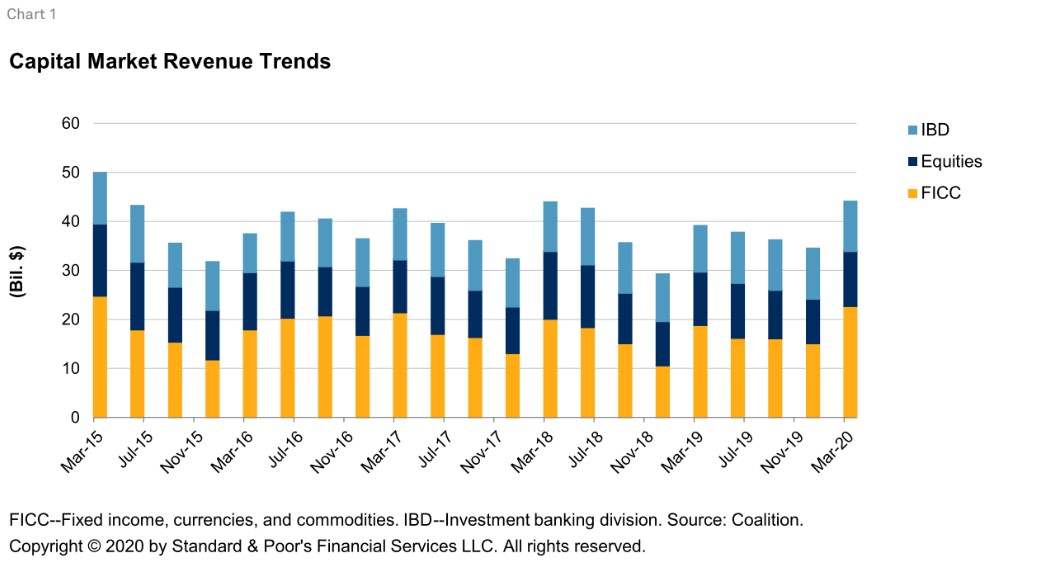
Capital markets fees are key
The credit-rating firm also charted how JPMorgan and Citigroup have lead their peers in capital markets revenue in most years since 2010.
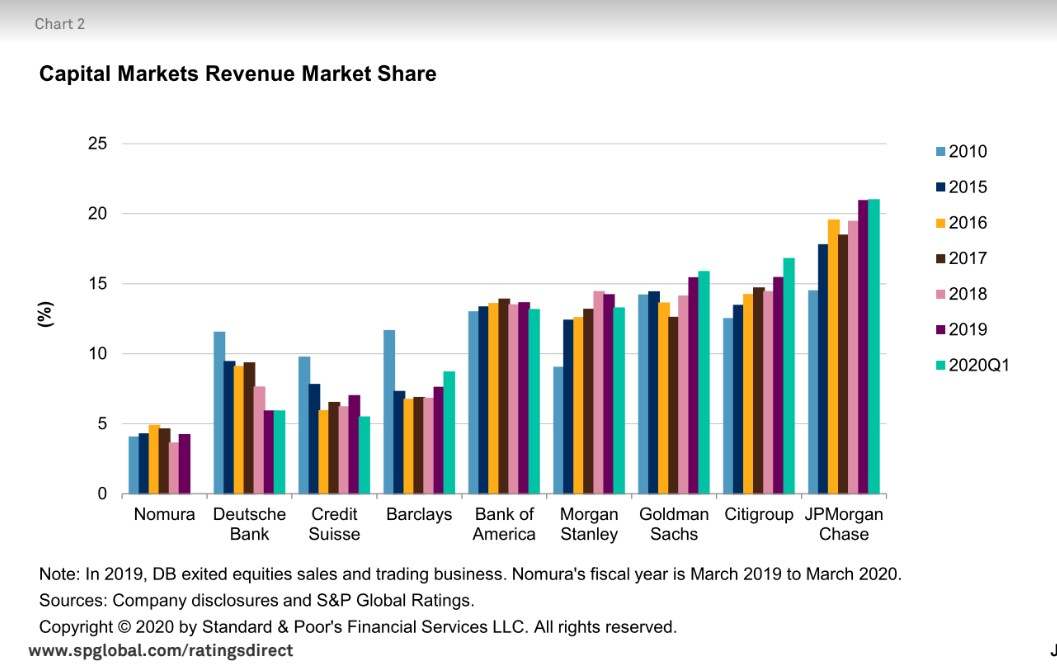
How the majors stack up
The Federal Reserve has increased its balance sheet to more than $7 trillion from less than $4 trillion about a year ago, in an effort to offset U.S. economic fallout during the pandemic.
Big banks kicked off the corporate earnings season on Tuesday. The Dow Jones Industrial Average DJIA, +2.13%, S&P 500 index SPX, +1.34% and Nasdaq Composite COMP, +0.94% ended the session sharply higher after Federal Reserve Gov. Lael Brainard called for sustained large-scale asset purchases by the U.S. central bank to help the economy rebound amid a “thick fog of uncertainty” brought on by COVID-19. #economicindex##CoronavirusWave2.0##BearishSentiment#
Reprinted from Marketwatch,the copyright all reserved by the original author.
면책 조항: 본 게시글에 표현된 견해는 전적으로 작성자의 견해이며 Followme의 공식 입장을 대변하지 않습니다. Followme는 제공된 정보의 정확성, 완전성 또는 신뢰성에 대해 책임을 지지 않으며, 서면으로 명시적으로 언급되지 않는 한 해당 내용을 기반으로 취해진 어떠한 조치에 대해서도 책임을 지지 않습니다.

더 오래된 의견은 없습니다. 소파를 가장 먼저 잡으십시오.