

ECB Looks to Defuse German Legal Timebomb Threatening Stimulus
Jana Randow and Carolynn Look, Bloomberg News
Empty spaces sit in an employee parking lot outside the European Central Bank (ECB) headquarters in Frankfurt, Germany, on Wednesday, April 29, 2020. The ECB’s response to the coronavirus has calmed markets while setting it on a path that could test its commitment to the mission to keep prices stable. Photographer: Alex Kraus/Bloomberg , Bloomberg
(Bloomberg) -- The European Central Bank’s most determined attempt yet to confront the German legal headache bedeviling its quantitative easing policy may emerge as soon as this week.
That’s what its president, Christine Lagarde, hinted at after its June 4 decision, saying that the account of that meeting due to be published this Thursday will include a description of officials’ justifications for continuing the measure. A German newspaper says additional documents may also be published to support the ECB’s arguments.
Policy makers are trying to address the demands of a constitutional court ruling that criticized Germany’s politicians and the European Union’s top tribunal for not properly scrutinizing the institution’s accumulation of more than 2 trillion euros ($2.3 trillion) in public-sector debt. That judgment threatens to bar the Bundesbank from participating in monetary stimulus.
The ruling produced a standoff between the chief legal authority of Europe’s biggest economy and the ECB, which argues it’s not answerable to national tribunals or parliaments. With time pressing however, and more litigation pending, Lagarde and her colleagues have since sought to engage in the matter.
One advantage of explaining themselves in the account is that it is one of only a few regular, official documents signed off and published by the decision-making Governing Council. So policy makers can collectively respond to the judgment there, explaining the costs and benefits of their bond-purchase tool, without communicating directly to the court.
Peter Huber, the judge who drafted the ruling, has kept up pressure on the ECB to respond, insisting that the institution isn’t a “master of the universe.” On Thursday, he argued that the central bank can’t start a “redistribution program.”
While the court set a deadline of early August for an explanation from the ECB of why the measure was proportionate, the window to act is much smaller because Germany’s Bundestag -- whose censure by judges makes it part of resolving the dispute -- is about to start its two-month summer recess.
The ECB’s legally mandated distance to national institutions is one aspect that has made the spat so complicated to address. In a bid to square that circle, Bundesbank President Jens Weidmann told lawmakers last week that his central bank could effectively be a messenger for whatever Lagarde and the Governing Council express on the matter.
“We’re looking for an appropriate solution that allows the government and the Bundestag to have access to the considerations of the ECB’s Governing Council,” Weidmann told Frankfurter Allgemeine Sonntagszeitung in an interview.
The ECB is currently compiling records documenting the proportionality of bond purchases that the Bundesbank will pass on to Berlin, according to Boersen-Zeitung. Policy makers could sign off on that plan on Wednesday.
The stakes are high for the ECB, with Europe’s economy crawling out of an unprecedented slump and in need of prolonged monetary support.
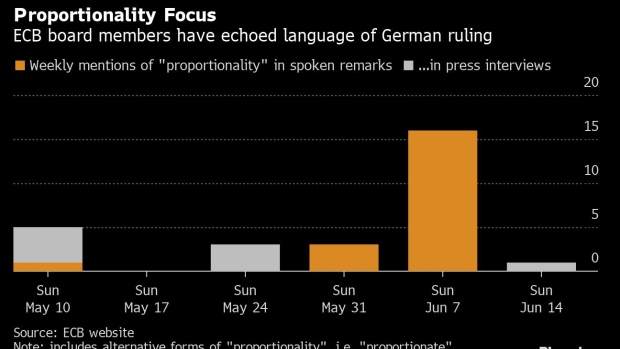
”The term ‘proportionality’ will be a key component of the ECB’s vocabulary going forward, especially if legal challenges persist,” said Carsten Brzeski, chief economist at ING Germany. “It’s another question whether such an analysis can actually be conducted before measures are implemented. It’s in the nature of an unconventional measure that you can’t completely know how it works ahead of time.”
Lagarde will have a further opportunity to respond to the court when she answers a written query by a German member of the European Parliament who also asked about the proportionality of QE. Such correspondence from the EU’s legislature is often used as a method of holding the ECB accountable.
More legal trouble is looming, this time focused on the ECB’s newest stimulus tool, launched to help fight the coronavirus crisis, that will see it buy 1.35 trillion euros of debt by the middle of next year. The right-wing Alternative for Germany party has said it will sue the parliament and the federal government to stop the Bundesbank’s participation in that program too.
As if anticipating such problems, Lagarde -- a lawyer by training -- has already set out a defense. During a recent appearance at the European Parliament in Brussels, she argued the latest initiative also meets the court’s demand for proportionality.
Reprinted from bnnbloomberg.ca, the copyright all reserved by the original author.
면책 조항: 본 게시글에 표현된 견해는 전적으로 작성자의 견해이며 Followme의 공식 입장을 대변하지 않습니다. Followme는 제공된 정보의 정확성, 완전성 또는 신뢰성에 대해 책임을 지지 않으며, 서면으로 명시적으로 언급되지 않는 한 해당 내용을 기반으로 취해진 어떠한 조치에 대해서도 책임을 지지 않습니다.

더 오래된 의견은 없습니다. 소파를 가장 먼저 잡으십시오.