

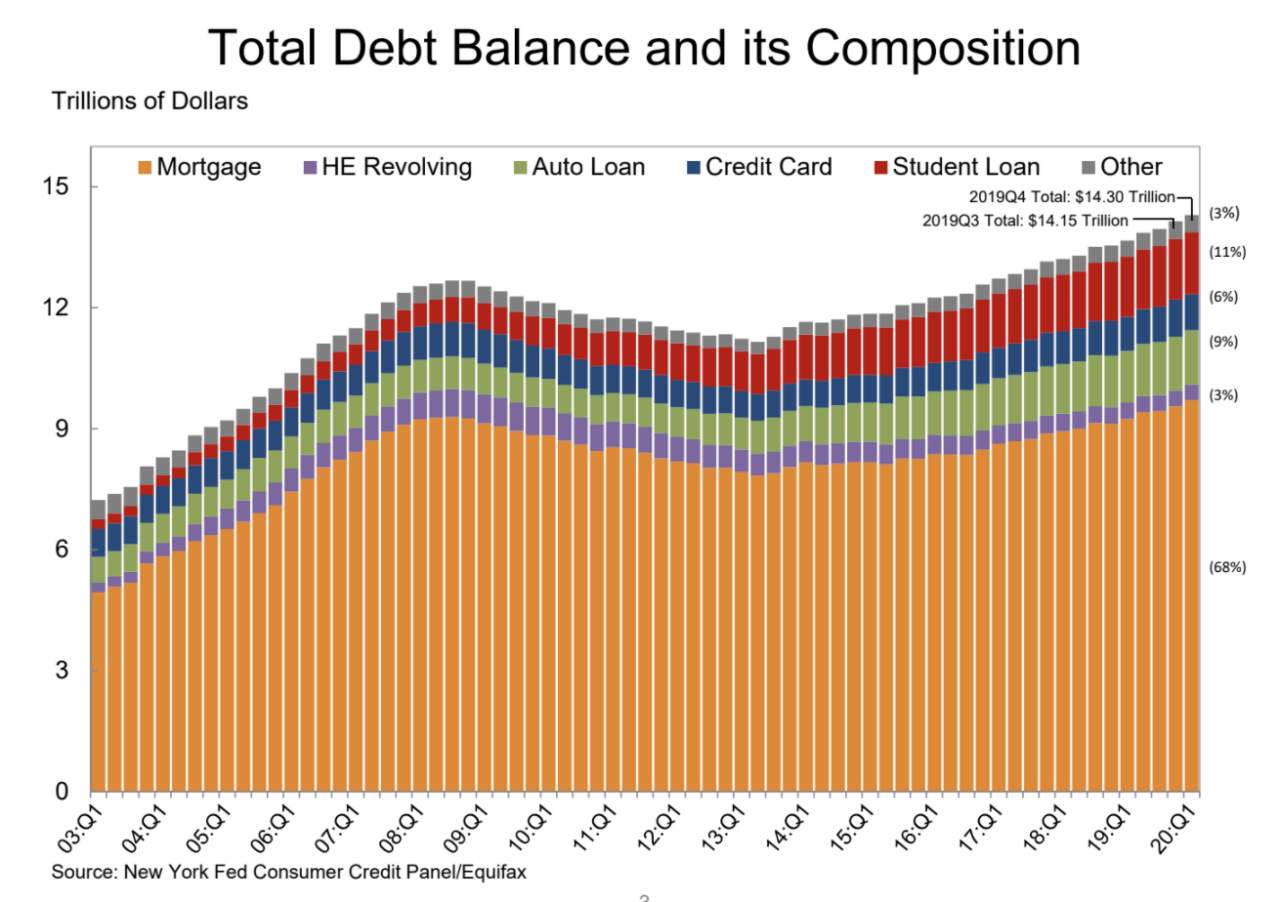
Total U.S. household debt reached a record $14.3 trillion after increasing by $155 billion, or 1.1%, in the first quarter of 2020, according to the Fed’s Quarterly Report on Household Debt and Credit.
The results do not fully capture the economic pain felt from the coronavirus pandemic and widespread societal shutdown: The report noted that “the data do not fully reflect the potential effects of COVID-19 that materialized in the second half of March 2020.” More than 30 million Americans filed unemployment claims between the second half of March and April.
The report, based on “a nationally representative sample of individual- and household-level debt and credit records drawn from anonymized Equifax credit data,” found that the total household debt is now nominally $1.6 trillion higher than the pre-recession peak of $12.68 trillion in the third quarter of 2008.
COVID-19 impact yet to be felt in Q1
Housing balances increased considerably, rising by $156 billion in the first quarter, to $9.71 trillion. At the same time, foreclosures were at a low: About 75,000 individuals saw a new foreclosure notation on their credit reports between January 1 and March 31, “remaining low by historical standards.”
Non-housing balances were relatively flat overall.
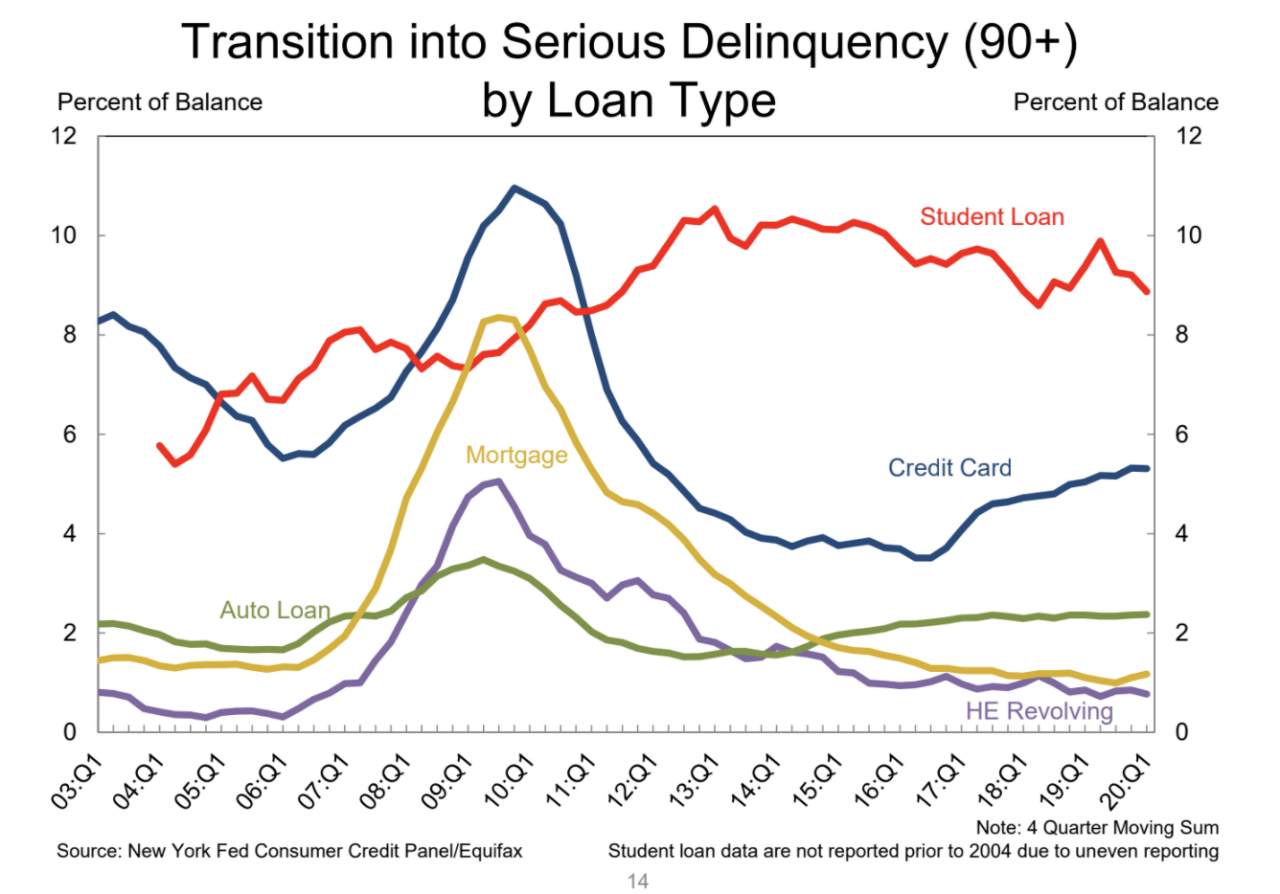
Auto loans increased by $15 billion to total $1.35 trillion. Student loans increased by $27 billion for a total of $1.54 trillion in the first quarter. About 10.8% of those loans were in serious delinquency or default in the first quarter, which was a small decline from 11.1% in the previous quarter.
The rise in both auto and student loan increases were largely offset by the decline in credit card balances and other forms of debt — a $39 billion drop.
“It is critical to note that the latest report reflects a time when many of the economic effects of the COVID-19 pandemic were only starting to be felt,” Andrew Haughwout, senior vice president at the New York Fed, said in a press release. “We will continue to monitor these developments and the broader state of household balance sheets closely as key data are updated and the economic situation evolves.”
The Labor Department is expected to release April’s jobs report on Friday, and economists expect the U.S. to have lost 21.3 million jobs in April, forecasting the unemployment rate to jump from 4.4% to 16%.
Reprinted from Yahoo Finance, the copyright all reserved by the original author.
면책 조항: 본 게시글에 표현된 견해는 전적으로 작성자의 견해이며 Followme의 공식 입장을 대변하지 않습니다. Followme는 제공된 정보의 정확성, 완전성 또는 신뢰성에 대해 책임을 지지 않으며, 서면으로 명시적으로 언급되지 않는 한 해당 내용을 기반으로 취해진 어떠한 조치에 대해서도 책임을 지지 않습니다.

더 오래된 의견은 없습니다. 소파를 가장 먼저 잡으십시오.