

What are safe haven assets?
Safe haven assets are where investors and traders invest their money to protect against fundamental damage. Safe-haven currencies, safe-haven stocks, gold, and U.S. Treasuries have traditionally maintained or increased their value during periods of economic downturn or general market volatility, which provide protection for losses that growth stocks may suffer in such cases.
Safe haven assets typically exhibit most or all of the following characteristics:
1) High liquidity
With considerable trading volume, you can enter and exit positions at the price you want without encountering a decline. An example of a high liquidity safe-haven currency pair is GBP / JPY. When there are signs of fundamental disruption, such as the economic recession, a common practice is to short the GBP/JYP-being able to enter a position at its original price will mean higher profits as prices fall further
2) Limited supply
If the supply of an asset exceeds the demand, its value will be weakened. The value of a scarce supply market like gold is likely to exist in this scarcity, and when market demand increases, its value may be even higher.
3) Different utilities
Does the asset have sufficient uses (such as in industrial applications) to meet huge demand? Take copper as an example, it has a wide range of uses in infrastructure, especially in the agricultural sector. When emerging markets accelerate, demand tends to increase.
4) Persistent demands
A true safe haven is expected to maintain demand in the future, so confidence in the future utility of the asset should be maintained. For example, while some commodities like silver may now have many industrial uses, they may be replaced by other commodities in the future.
5) Permanent
As the utility decreases, the quality of an asset may decline, and future market demand may also decrease.
Best safe-haven assets for trading
When trading safe-haven assets, you can choose currency pairs, US Treasuries, commodities, and even defensive stocks (also known as safe-haven stocks). Let’s take a look at some of the most common safe-haven asset transactions.
Gold
The most noteworthy safe-haven commodity is gold. Historically, there has been a reliable negative correlation between gold and stocks. The market demand for this coveted tangible asset is high, exists independently of monetary policy decisions, and supplies are tight.
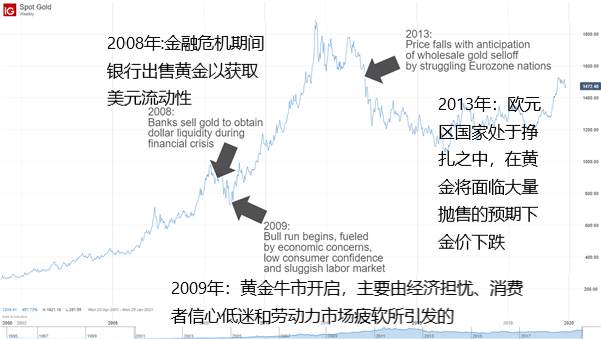
After the financial crisis broke out in 2009, investors flocked to gold, prompting the price of gold to climb in the three-year bull market, reaching $1,900 per ounce in August 2011. Although the price of gold soared in the next two years, the ongoing bear market has never lasted, which has strengthened its safe-haven status. The chart below shows the main price movements of gold since the turn of the century.
Yen
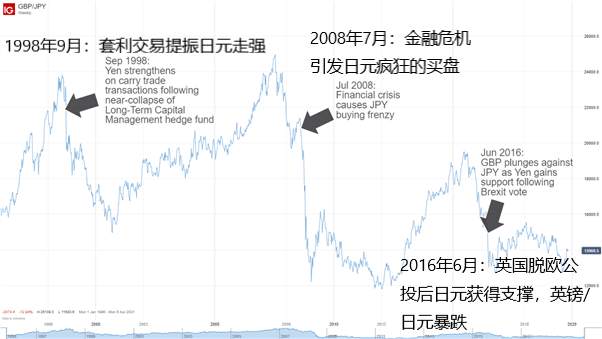
The yen is considered one of the most reliable safe-haven currencies due to the trade surplus of the yen and its status as a net creditor nation of the world, the market's demand for arbitrage of its currency, and self-fulfilling predictions caused by these factors. The figure below shows three examples, in which you can see that the yen has acted as a safe haven in the safe-haven market for the past three decades.
Defensive stocks
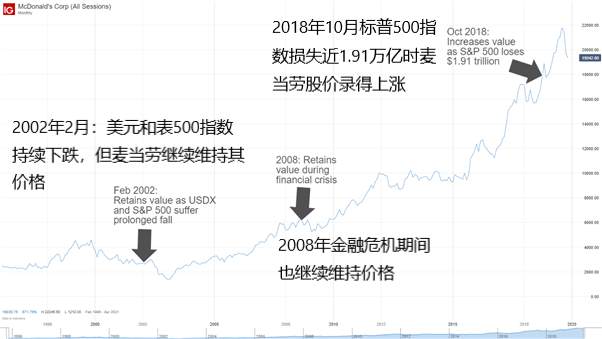
Although growth stocks usually fall in a wider range of market turmoil, certain stocks can maintain or increase their value during difficult economic times. This is because some companies in industries such as consumer goods and utilities have high demand for products and services, even in difficult economic times. The chart below shows three examples of how McDonald's weathered the economic turmoil of this century.
US Treasury
U.S. Treasuries are considered a safe haven because of their risk-free nature; the government repays these debt securities when the bills mature.
How to trade safe-haven assets?
Now that we have identified which markets to trade, do you know how and when to trade? The market is volatile and traders should study the prices of assets such as growth stocks, the US dollar index, industrial commodities, as well as employment data and Fundamental factors such as GDP to understand how the economy is performing. This will give you a better understanding of when a downturn is likely and when to invest a portion of your portfolio in more defensive assets.
For example, there are three factors that can predict a recession:
The U.S. Treasury yield curve is upside down: Although the yield curve does not necessarily decline when it reverses, this event is indeed a prelude to recession in history.
Bad business / consumer confidence data: If consumers and businesses do not have confidence in the economy, they are less likely to spend or invest in the future, which may lead to a contraction in economic growth and a downturn in the economy.
Negative employment statistics: Employment statistics not only provide insight into recruitment intentions, but also length of work. When companies cut hours or hire temporary workers, they may be nervous about economic conditions.
Safe haven assets: key takeaways
Pay close attention to fundamentals: As mentioned earlier, fundamental factors such as employment statistics and business confidence can predict both a market downturn and an economic boom. Therefore, following as many fundamental factors as possible will give you a good measure of when to enter-and when to leave-a haven.
Consider technical indicators: When an asset enters an overbought / oversold area, indicators such as the relative strength index will be displayed. Combined with fundamental factors, this can give investors a clearer idea of when to enter or exit a transaction.
Historical price movements are important: keep in mind that sometimes hedge assets may not perform as expected. For example, with the advent of the financial crisis, the market had expected gold to soar in 2008-but instead, banks exchanged reserves for cash to increase the liquidity of the dollar. Gold did not enter the bull market until the following year.
면책 조항: 본 게시글에 표현된 견해는 전적으로 작성자의 견해이며 Followme의 공식 입장을 대변하지 않습니다. Followme는 제공된 정보의 정확성, 완전성 또는 신뢰성에 대해 책임을 지지 않으며, 서면으로 명시적으로 언급되지 않는 한 해당 내용을 기반으로 취해진 어떠한 조치에 대해서도 책임을 지지 않습니다.

더 오래된 의견은 없습니다. 소파를 가장 먼저 잡으십시오.